The Word Before the Action
Who gets to decide what counts as human? It is a question that sounds philosophical until another person answers it for you. For many people, the boundaries of personhood remain sufficiently abstract that they can be discussed from a comfortable intellectual distance. For those who have experienced being reduced, stereotyped, dismissed, or described through dehumanizing language, however, the question becomes considerably less theoretical. It becomes embodied. It becomes social. It becomes personal.
I remember being called a monster not simply because the word was cruel, but because of everything that seemed to exist beneath it. The word did not merely communicate anger or disapproval. It supplied an interpretation of who I was and, by implication, how I ought to be understood. Within a single designation, a complicated human being could be compressed into an image of something threatening, aberrant, or fundamentally outside the boundaries of ordinary recognition. The word therefore possessed a significance beyond its immediate emotional force. It became a verdict.
We frequently distinguish between words and actions as though they occupy separate moral territories. Words are considered intangible, while actions are considered consequential. Someone may say something hurtful, apologize, and be expected to move forward, whereas physical or institutional conduct is generally regarded as possessing greater seriousness. Yet language is rarely as passive as this distinction suggests. Words classify, characterize, authorize, diminish, and sometimes condemn. They influence what we notice about other people and what we subsequently believe their behavior means. When a particular description becomes sufficiently established, it can shape the circumstances in which later actions are interpreted.
The word can precede the action, but that does not mean the word itself is without consequence. Language can establish a conceptual environment in which certain responses become easier to imagine, easier to justify, or easier to ignore. A person described as incapable may receive fewer opportunities to demonstrate competence. Someone described as dangerous may encounter suspicion before they have done anything threatening. Someone characterized as difficult may have legitimate concerns discounted before those concerns are even examined. In these circumstances, the language does not merely describe the person; it participates in constructing the social reality in which that person must live.
This is why I return to the word monster. I do not return to it because I believe a single word possesses the authority to define me. I return to it because the word reveals something about the assumptions that make such a description possible. It exposes the distance between being seen and being recognized, between being perceived and being understood, and between being regarded as different and being regarded as less human.
The question, therefore, is not only what the word meant. It is what the word did.
When Language Becomes an Action
To say that words matter is not to suggest that every unpleasant statement produces the same degree or kind of harm. Context matters, as do intention, relationship, power, history, and circumstance. There is a meaningful difference between an ill-considered remark, an insult, a threat, an institutional classification, and a deliberate attempt to strip another person of dignity. Nevertheless, these differences should not lead us toward the opposite conclusion that language is somehow inconsequential simply because it does not leave a physical mark.
Language can act upon the social world.
A promise creates an expectation. A declaration establishes a position. A command attempts to alter another person’s behavior. A diagnosis can influence access to services and determine how institutions interpret an individual’s needs. A verdict can alter someone’s legal circumstances. A label can affect whether another person’s testimony is believed. Speech, in other words, is capable of producing consequences precisely because human beings do not merely hear words; we organize our understanding of one another through them.
This becomes especially important when language is connected to social power. A description made in private may remain an interpersonal injury, while the same description repeated within an institution can become a rationale for exclusion. The difference does not necessarily reside in the vocabulary itself. It resides in what authority accompanies the vocabulary and what other people are prepared to do because they believe it.
For disabled people, this relationship between language and action is particularly significant. A disabled person may be described as incapable and subsequently denied an opportunity. They may be characterized as disruptive and subsequently removed from an environment. They may be perceived as irrational and consequently have their testimony discounted. They may be regarded as dependent and find decisions concerning their own lives increasingly made on their behalf. In each case, the language does not mechanically cause the outcome, but it can create the interpretive conditions through which the outcome becomes intelligible.
This is why the question of language should not be reduced to whether someone was “just using words.” Words can establish social relationships, and social relationships can establish the boundaries of what people believe they are permitted to do. A dehumanizing description may therefore be both expression and action: an expression of what someone believes and an action that positions another human being within a hierarchy of worth.
The more consequential question is not simply what a word means, but what it makes possible.
The Architecture of Otherness
Human societies depend upon categories. We use them to communicate, organize institutions, understand experiences, and identify differences that might otherwise remain difficult to articulate. Classification itself is not inherently oppressive. Indeed, accurate language can provide disabled people with recognition, community, resources, and the ability to describe experiences that may previously have felt incomprehensible.
The problem begins when classification becomes hierarchy.
Once one way of being is established as the normative standard against which all others are measured, difference can gradually become deficiency. The individual is no longer simply described as having a different mode of communication, perception, mobility, cognition, or participation. Instead, their divergence from the prevailing standard becomes evidence that something is wrong with them.
Disability has repeatedly been situated within this paradigm. The disabled person is frequently expected to explain the deviation before society examines the standard itself. Why does this person communicate differently? Why do they require additional time? Why do they need an accommodation? Why do they experience an environment differently from everyone else? Why can they not simply behave in the way expected of them?
These questions may appear reasonable when considered individually, but collectively they reveal a larger assumption: that the environment is fundamentally neutral and that the person who experiences difficulty within it is the primary source of the problem.
This is one of the ways ableism maintains its hegemony. It does not always announce itself through explicit hostility. Often, it operates through ordinary expectations that have become so familiar that they no longer appear ideological. Certain forms of communication are regarded as inherently more legitimate. Certain bodies are treated as more productive. Certain expressions of emotion are considered more rational.
Certain forms of independence are interpreted as evidence of maturity, while reliance upon others is treated as evidence of deficiency.
The paradigm becomes most powerful when it becomes invisible.
What is customary begins to appear natural. What appears natural begins to seem unquestionable. What becomes unquestionable can become extraordinarily difficult to challenge.
The Phenomenology of Being Seen
There is a particular experience involved in being perceived through assumptions that precede you. One enters a room as oneself, yet discovers that other people may already possess an interpretation of what one’s presence means. A mannerism can become evidence of instability. A communication difference can become evidence of rudeness. A request for assistance can become evidence of incompetence. An emotional response can become evidence of irrationality. A refusal to comply with an unreasonable expectation can become evidence of defiance.
The individual may know what they intended, but intention can become almost irrelevant once another person has constructed a sufficiently persuasive explanation for their behavior.
This is the phenomenology of being seen without necessarily being recognized.
For many disabled people, social interaction can involve a continual negotiation between selfhood and perception. One learns which behaviors require explanation, which needs require justification, which differences should be disclosed, and which aspects of oneself may be misinterpreted. This can produce an exhausting form of social vigilance in which a person is not merely navigating an environment but simultaneously monitoring how that environment is interpreting them.
The contradiction is difficult to escape. A disabled person may be encouraged to advocate for themselves, but not to appear difficult. They may be expected to communicate their needs, but not make those needs inconvenient. They may be encouraged to exercise independence while simultaneously being judged according to standards that disregard the conditions necessary for them to exercise that independence. They may be told to be authentic while learning that authenticity itself can become socially costly.
Eventually, the question becomes more complicated than whether one is being understood. It becomes a question of whether society is asking a person to become understandable or asking them to become less different.
Those are not the same request.
The first invites communication. The second demands conformity.
When Difference Becomes Threat
The transformation of difference into threat is one of the more consequential operations of language. Unfamiliarity is not inherently dangerous, yet human beings often interpret what they cannot immediately understand through the vocabulary already available to them. When that vocabulary is saturated with stereotypes, the unfamiliar person can become threatening almost by default.
For disabled people whose behavior does not conform to conventional expectations, the consequences can be substantial. A person experiencing sensory overload may be described as disruptive. A person communicating atypically may be regarded as suspicious. A person experiencing distress may be interpreted as aggressive. A person requesting assistance may be perceived as incapable. A person challenging an inaccessible environment may be characterized as unreasonable.
The description precedes the interpretation, and the interpretation can precede the response.
Once an individual has been linguistically positioned as difficult, dangerous, incapable, or irrational, subsequent behavior may be interpreted through that frame. The person no longer receives the same benefit of ambiguity that others might receive. Actions that could have several explanations are reduced to a single presumed motive, and each new interaction becomes additional evidence for a conclusion that was established before the interaction began.
This is one of the quieter mechanisms of dehumanization. The individual is no longer encountered as a complicated human being whose behavior might have multiple explanations. Instead, they become a category. Categories can be easier to manage than people because categories do not require the same degree of curiosity.
People do.
The Politics of the Label
There is power in naming because naming determines what becomes visible. For disabled people, accurate language can be profoundly liberating. A person may finally encounter vocabulary that explains an experience they previously believed was unique to them. A diagnosis, identity term, or community designation can provide recognition, connection, and access to resources. Language can therefore be an instrument of self-determination.
Yet language becomes considerably more complicated when the label is imposed without regard for the person being labeled.
There is a meaningful difference between saying, “This is how I understand my experience,” and saying, “This is what you are, and therefore this is how I will treat you.” The first can constitute self-definition. The second can become social confinement.
This distinction matters because disabled people have historically been described by institutions before they were listened to as individuals. Medical, educational, governmental, and social systems have all developed classification systems intended to describe human difference. Some classifications have expanded recognition and access, while others have historically been used to justify segregation, exclusion, institutionalization, or diminished expectations.
The issue, therefore, is not that classification is inherently oppressive. The issue is what happens when codification becomes destiny.
When a category intended to describe a person begins determining what that person is presumed capable of, the classification has ceased to be merely descriptive. It has become prescriptive. The label begins to speak before the individual has the opportunity to speak for themselves.
That is one reason self-advocacy matters. It introduces another voice into the process of interpretation: the voice of the person who must actually live within the category being discussed.
The Word Can Become Permission
Language can influence what people believe they are permitted to do to one another. A person described as incapable may be denied an opportunity in the name of prudence. Someone described as dangerous may be subjected to greater surveillance in the name of safety. Someone characterized as burdensome may find their needs treated as excessive. Someone regarded as childlike may discover that decisions concerning their own life are increasingly made without them.
The descriptions differ, but they share a structural problem. Each can reduce a person to an interpretation that becomes more authoritative than the person themselves.
This is where words and actions intersect most clearly.
The language may not directly command the action, but it can create the conceptual environment in which the action appears reasonable. The vocabulary of incapacity can make exclusion appear protective. The vocabulary of danger can make restriction appear necessary. The vocabulary of burden can make neglect appear efficient.
None of this means that every negative description inevitably produces discrimination. Such a conclusion would be too simplistic. Rather, the point is that language contributes to the interpretive framework through which behavior is judged. When that framework is repeatedly reinforced, it can influence institutions as well as individuals.
The word can become permission.
And once permission has been culturally established, the action may no longer appear extraordinary.
Beyond the Myth of Independence
Few concepts require more careful examination within disability discourse than independence. Independence is undeniably valuable when it means having meaningful control over one’s decisions, relationships, resources, and future. Yet independence becomes problematic when it is treated as the highest measure of human worth or when receiving support is interpreted as evidence of personal deficiency.
Complete self-sufficiency is, in reality, largely a cultural fiction.
Human beings depend upon one another constantly. We rely upon transportation systems, infrastructure, technology, family members, colleagues, public institutions, educators, healthcare professionals, and countless forms of labor that become so ordinary we cease to notice them. What distinguishes disability is often not the existence of dependence but the degree to which that dependence becomes visible and socially contested.
Interdependence offers a more honest paradigm.
A person can require support and still possess agency. An accommodation can increase autonomy rather than diminish it. Assistance can be a mechanism through which a person exercises choice rather than evidence that they lack the capacity to choose. To rely upon another person does not inherently make someone less competent, less mature, or less human.
Collective access extends this principle beyond individual relationships. Accessibility should not be conceptualized solely as something provided to an exceptional individual after they have demonstrated sufficient need. It can instead be understood as a collective responsibility to create environments in which different bodies, minds, communication styles, and methods of participation can coexist without one being treated as the universal standard.
The question consequently changes from “How can we make this person fit the environment?” to “What would it take to create an environment in which more people can participate without having to conceal the conditions of their participation?”
That is not merely an accessibility question.
It is a question about the kind of society we are willing to construct.
Accountability Without Dehumanization
Disability justice should not require the abandonment of accountability. Disabled people, like everyone else, can make mistakes, hurt others, violate boundaries, and behave in ways that require criticism, repair, or consequence. Rejecting ableism does not mean placing disabled people beyond moral scrutiny. It means refusing to confuse moral accountability with the denial of personhood.
A person can be told that their conduct was harmful without being told that their existence is inherently harmful. A boundary can be established without reducing another person to a stereotype. A disagreement can remain a disagreement without becoming a referendum on someone’s humanity.
This distinction is essential because advocacy loses its ethical foundation if it merely reverses the hierarchy it seeks to dismantle. The goal is not to create a world in which disabled people are automatically believed, automatically praised, or automatically exempt from criticism. Nor should disability become a shield against legitimate accountability.
The goal is more fundamental: disabled people should enter the conversation as people.
Their humanity should not have to be established before their conduct can be discussed. Their disability should not automatically determine the interpretation of their behavior. Their need for support should not erase their agency, just as their agency should not erase their need for support.
Accountability and dignity can coexist.
Indeed, a just society should demand that they do.
The Monster We Construct
Perhaps the most unsettling aspect of the word monster is that monsters are rarely created fully formed within language. They are constructed through accumulation. The unfamiliar becomes strange. The strange becomes threatening. The threatening becomes morally suspect. The morally suspect becomes someone whose exclusion can be rationalized.
At each stage, language supplies another piece of the architecture.
The monster is therefore not simply an individual. It is an idea produced when complexity becomes intolerable and difference becomes easier to fear than understand.
The category provides psychological distance, allowing the observer to imagine that the person being described belongs to an entirely different moral universe.
Disability exposes the fragility of this construction because disability disrupts so many assumptions about what human beings are supposed to be. We do not all communicate in the same way. We do not all process sensory information in the same way. We do not all move through environments in the same way. We do not all require the same degree of assistance. We do not all experience autonomy through identical forms of independence.
The human condition has never been as standardized as our institutions sometimes imply.
Perhaps that is why disability remains such an important site of social inquiry. It exposes the limits of a paradigm that treats one particular mode of embodiment, communication, productivity, and independence as though it were the neutral foundation of human existence.
Disability does not create the instability in that paradigm. It reveals it.
What the Word Revealed
I do not remember being called a monster because I believe the word possesses some mystical authority over who I am. I remember it because the word revealed the distance between how I understood myself and how someone else had decided to understand me. That distance matters because it exists in many of the ordinary places where disabled people encounter society.
It exists in workplaces where disabled employees are judged according to standards that disregard how they actually function. It exists in schools where compliance can be mistaken for competence. It exists in public spaces where accessibility is treated as an exception rather than a shared responsibility. It exists within families where concern can become control. It exists within institutions where a person’s support needs become more visible than their aspirations.
It also exists whenever a disabled person must spend more energy proving that they are capable of participating than actually participating.
That experience can be particularly insidious because it rarely announces itself as dehumanization. It may present itself as concern, efficiency, professionalism, safety, or practicality. Yet beneath those terms can exist assumptions about whose needs matter and whose differences are tolerable.
This is why I have become less interested in asking whether a particular word was intended to cause harm and more interested in examining what that word makes possible. Intent matters, but impact matters too. Context matters. Power matters. History matters. The social meaning of language cannot always be separated from the structures in which that language operates.
A word may reveal an attitude, but it can also reinforce a system.
Who Gets to Decide?
Who gets to decide what counts as human?
No individual should possess that authority. No institution should possess it. No diagnosis should possess it. No stereotype should possess it. And no word should possess enough power to determine whether another person receives recognition, dignity, access, or belonging.
Yet the question persists because societies continually establish boundaries around normality. They decide whose communication is legitimate, whose body is acceptable, whose needs are reasonable, whose behavior is threatening, whose dependence is tolerable, and whose difference requires correction.
The work of disability advocacy is therefore not limited to requesting inclusion within an existing paradigm. Sometimes it requires interrogating the paradigm itself. It requires asking why environments are constructed in ways that compel some people to repeatedly request permission to participate. It requires examining why accessibility is so often framed as generosity rather than justice. It requires understanding interdependence not as evidence of deficiency but as an ordinary condition of human existence.
It also requires recognizing that collective access benefits from a transformation in social imagination. Accessibility cannot be sustained solely through individualized accommodations while the underlying environment continues to treat difference as exceptional. Anti-ableist norms require a more fundamental shift: difference must become something society expects rather than something it regards as an interruption.
The question is no longer simply whether disabled people can fit within existing structures.
It is whether those structures are capable of accommodating the complexity of human life.
The Person Beneath the Word
There are words that remain with us, not necessarily because they are accurate, but because they force us to confront something about the world in which they were spoken. Monster is one of those words for me. I could have allowed it to become a definition. Instead, I became interested in the question beneath it: What had to be believed about me for that word to make sense?
That question ultimately leads beyond the individual encounter. What assumptions about disability, behavior, difference, and humanity were operating beneath the language? How many other disabled people have encountered variations of the same logic without possessing the vocabulary to describe what happened? How many have had their behavior interpreted before they were heard, their needs evaluated before they were understood, or their humanity quietly negotiated through words that seemed ordinary to everyone except the person required to live beneath them?
These questions matter more to me than the insult itself.
If we focus exclusively on the person who used the word, we may miss the larger structure that gave the word its force. The problem is not merely that someone can call another person a monster. The problem is that society has repeatedly developed vocabularies through which certain human beings can be imagined as less capable, less credible, less deserving, or less human.
Once that imagination takes hold, action can follow. Exclusion can follow. Silencing can follow. Surveillance can follow. Control can follow. The history of disability demonstrates that words and actions are not always separated by a clean boundary.
Sometimes they exist within the same continuum, each reinforcing the other.
That is why language deserves accountability. Not because every imperfect word constitutes violence, and not because every poorly chosen phrase should be treated as equivalent to physical or institutional harm, but because language helps determine what we notice, what we disregard, whom we believe, whom we fear, and whom we consider worthy of accommodation.
The question is not simply what we call one another. The question is what our words allow us to believe about one another, and what those beliefs make possible afterward.
Perhaps that is the lesson I ultimately took from being called a monster. I was never required to become more human in order to deserve humanity. I was already human. The responsibility was never mine to prove it.
The more important task is to examine the structures of thought that make such proof seem necessary in the first place.
If disability advocacy is to move beyond accommodation toward genuine collective access, then it must also confront the language through which disabled people are perceived. It must challenge the hegemony of normalcy without replacing it with another rigid hierarchy. It must recognize interdependence without romanticizing dependence. It must pursue accountability without dehumanization. And it must remain attentive to the interstices where words become assumptions, assumptions become judgments, and judgments become actions.
Because sometimes the most consequential question is not whether a word was intended to hurt.
It is whether we are willing to examine what that word has taught us to believe about one another.
Note of Thanks
I would like to extend my sincere appreciation to the disabled people, self-advocates, advocates, families, allies, educators, professionals, and community members whose experiences continue to challenge conventional understandings of disability and human difference. Their willingness to question established paradigms, articulate experiences that are often difficult to translate into institutional language, and advocate for greater collective access has contributed meaningfully to the broader movement toward disability justice.
I am particularly grateful to those who have demonstrated that advocacy does not require uniformity. The disability community encompasses a remarkable plurality of experiences, identities, communication styles, support needs, and relationships to autonomy. That plurality is not a weakness within the movement; it is one of its intellectual and political strengths. A meaningful disability-justice framework must therefore leave room for disagreement, complexity, and individual experience rather than reducing an extraordinarily diverse community to a singular narrative.
I also extend my appreciation to those who have taught me that language deserves examination. The words we inherit are not always neutral, and the meanings attached to them can carry histories considerably larger than the moments in which they are spoken. To examine language is therefore not merely to police vocabulary; it is to investigate the social assumptions that vocabulary can preserve, challenge, or transform.
This article is offered neither as a universal account of disability nor as an attempt to speak for every disabled person. It is instead an invitation to remain intellectually curious about the relationship between language and power, perception and action, difference and belonging, autonomy and interdependence.
May our advocacy continue moving beyond the question of whether disabled people can fit within existing systems and toward the more consequential question of whether those systems are capable of recognizing the full complexity of human life.
Because before we ask whether someone belongs, we should first ask why their humanity was ever placed in question.
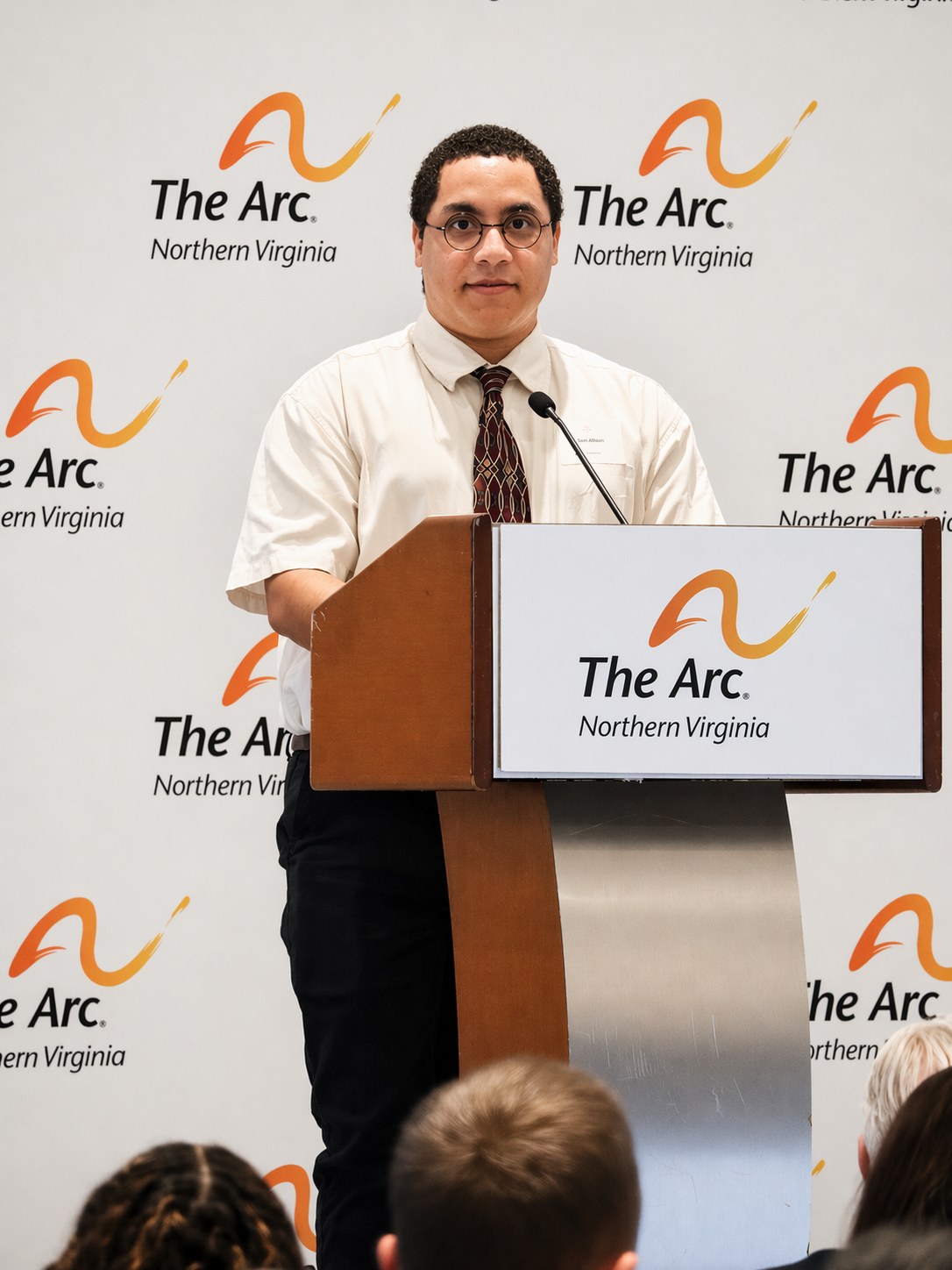
Ian Allan
Self-Advocate for The Arc of Northern Virginia