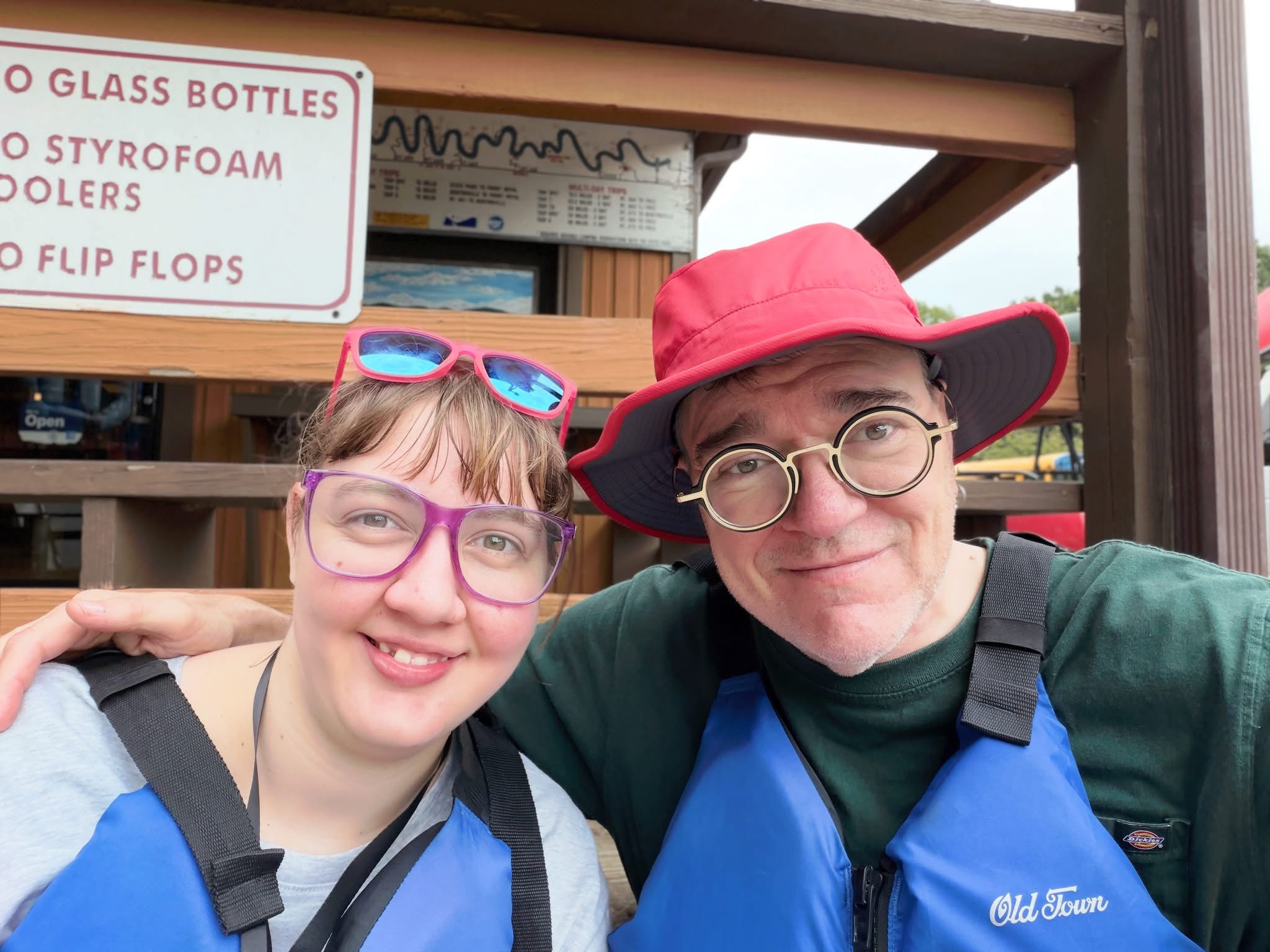
Not long after we launched, we entered a rapid at the wrong angle and slammed sideways into a large rock. The current pinned the canoe against it and flipped us into the water. We both went under.
When we surfaced, we managed to get alongside the canoe, but it was still pinned against the rock by the strong current. We tried to free it, but within a few minutes we were exhausted. The water was rushing around us, and Schuyler was understandably frightened.
Before we launched that morning, however, we had watched a safety video. Among other things, it explained what to do if you find yourself in the water in a rapid: don’t try to stand up. Instead, float on your back with your feet pointing downstream and let the current carry you out of the rapid.
I asked Schuyler if she remembered. She said she did, and then demonstrated the position she was told to take, her hands crossed against her chest holding onto her safety vest. Then I asked her to do something that went against every instinct I had as her father. I told her to let the river carry her away from me.
And she did.
She didn’t panic. She didn’t argue or freeze. She remembered what she had been taught, got herself into the position we’d seen in the video, and rode the current downstream.
It certainly wasn’t graceful. She bounced off some rocks along the way. But she made it through the rapid and into calmer water, where other canoeists who had seen our accident helped her safely to shore.
I didn’t fare quite as well. When I finally freed the canoe, it knocked me into the current, and I took my own much less elegant trip through the rapids. By the time I reached calmer water, I was bleeding from my knee and shin and had wrenched my back. I know I didn’t hit every rock in the river, but it certainly wasn’t for lack of trying.
For several minutes, though, I couldn’t see Schuyler. I called her name and heard nothing. Those were some of the longest minutes of my life. They are the ones that have stuck with me.
Eventually I reached a group of canoeists who had stopped to help us. As they pulled me toward shore, I asked whether they had found my daughter. Before anyone could answer, I heard Schuyler laughing. She was standing safely on the bank. We’d both made it, bleeding and bruised but intact, grateful and perhaps just a little smarter than before.
I’ve thought a great deal about that moment since then, and particularly about what it says about independence, and about some of the assumptions I’ve made about Schuyler’s own independence over the years.
Schuyler has an intellectual disability. Throughout her life, people have sometimes made assumptions about what she can understand, what she can do for herself, and how much protection she needs from the world. Those assumptions are often well intentioned.
As her father, I’m a little ashamed to admit, I’ve certainly made many of them myself.
That’s not always easy for me to admit. I’ve spent much of Schuyler’s life advocating for people to see her possibilities rather than her limitations. And yet when the possibilities involve real risk, I’ve sometimes discovered limits to my own imagination.
Driving is a good example. The idea of Schuyler getting a driver’s license has frightened me for years. Driving carries real responsibility and real consequences. It requires judgment, attention and an ability to respond when something unexpected happens. As her father, it’s very easy for me to look at those risks and think first about all the things that could go wrong.
But standing in that river, or more accurately, desperately trying to stay afloat in it, I watched Schuyler do exactly what we ask of people when we give them greater responsibility for their own lives.
She listened. She learned. She remembered. And when something unexpected and frightening happened, she acted. That doesn’t mean I’m handing her my car keys tomorrow. I’m still her father, after all, and apparently worry is a renewable resource. But our experience on the river forced me to consider how easily concern for someone’s safety can become a reason to lower our expectations for them.
There is a difficult balance between protecting someone and empowering them. Most parents probably wrestle with that balance throughout their children’s lives, but for parents of people with disabilities, it can become particularly complicated. The world presents genuine risks. Some kinds of support really are necessary.
But independence doesn’t mean never needing help.
Neither of us got out of that river entirely by ourselves. Strangers helped Schuyler from the water. Other paddlers helped me and recovered our canoe. Eventually the outfitter came and picked us up. It took a small community to get the two of us safely home.
Independence often means something different. It means having access to information. It means being included when important things are being explained rather than assuming someone else will handle them for you. It means being given opportunities to learn and practice skills. It means having support available when you need it. And perhaps most importantly, it means being trusted to use those skills yourself.
We didn’t watch the safety video that morning because Schuyler has a disability. We watched it because we were both going onto the river. The information was for both of us. And when we needed it, Schuyler used it.
That’s something I’ve continued thinking about in the weeks since our accident. How often have I taken responsibility for Schuyler’s safety simply because I’m her father? How often have I assumed that keeping her safe was primarily my job rather than something she could increasingly take responsibility for herself? And how often might my own fear, not her ability, have determined where I believed the boundaries of her independence should be?
Those aren’t comfortable questions. They are, however, questions that feel very much at home at The Arc of Northern Virginia.
Our work is grounded in the belief that people with intellectual and developmental disabilities should have the opportunity to live lives of inclusion, choice and self-determination. That doesn’t mean pretending risks don’t exist. It means providing people with the information and support they need to understand those risks, make choices and take greater ownership of their own lives.
Sometimes support means reaching out a hand. And sometimes it means trusting someone enough to let go.
There was a moment in that rapid when every instinct I had told me to keep my daughter beside me. Instead, keeping her safe meant trusting her enough to let her go. Schuyler knew what to do. And perhaps the most important lesson I brought home from the river is that I need to trust her to know what to do a little more often.
I’ve spent a lot of time since that day telling this story from my perspective. So it seems only right that Schuyler gets the last word. Here’s how she describes what happened:
“When we hit the rocks, I was scared of drown but before we got into the canoe, i watched a video about how to be safe and be careful if the canoe crashed. I had my life jacket on and I had a waterproof phone bag. So I went on my back and held onto the one of the bags and my phone, and I got away from the rocks. Then the fishermen came and pulled me out of the water and I was so scared about not seeing my dad around and i saw the canoe and then I saw them pulled my dad out of the water. I thought I’d never see him again but when I saw him I laughed and I told him ‘we got a little bit hurt but we did it!’ I was scared and nervous that I could mess up but I knew that I would do it and I was a superstar in the end.”