Prelude: On the World’s Habit of Asking Us to Fade
There exist societies that mistake uniformity for order, conformity for civility, and silence for social equilibrium. Contemporary culture is frequently among them. It articulates commitments to individuality in ceremonial language while simultaneously administering quotidian penalties to those whose embodiment, cognition, affect, pace, or relational modes exceed the narrow bandwidth of what is deemed acceptable.
Thus emerges one of modern public life’s more subtle contradictions: individuality is affirmed in principle while constrained in practice. We are encouraged to “be ourselves,” provided that the self remains administratively convenient, institutionally legible, and socially non-disruptive.
Authenticity is welcomed when it can be consumed without structural consequence. It is celebrated when it aligns with institutional branding, inspirational narratives, or marketable representations of difference. Yet when authenticity demands redesign, redistribution, interpretive humility, or a reconfiguration of inherited privilege, institutional enthusiasm frequently diminishes. What was once framed as courage is quietly reclassified as inconvenience.
For disabled people, autistic people, neurodivergent people, trauma survivors, queer individuals, and others whose lives unfold in the interstices of dominant paradigms, this contradiction is not episodic but atmospheric. It informs hiring practices, educational assumptions, clinical interpretation, familial expectations, and the micro-politics of everyday judgment.
I write from within this terrain. I am both autistic and neurodivergent. My lived experience has involved sustained navigation of environments in which sensory needs are minimized, communicative differences are misread, and the legitimacy of one’s internal experience is often contingent upon conformity to neurotypical expectations.
These are not isolated grievances but structural phenomena, reflective of broader regimes of valuation.
The central question, therefore, is not whether authenticity is valued in abstraction, but which authenticities are permitted to circulate without penalty.
The Pale Grammar of Permission
Every social order develops a grammar: a set of formal and informal rules that determine what counts as intelligible expression, credible emotion, legitimate need, and recognizable humanity. In contemporary societies, this grammar is frequently shaped by neurotypical, able-bodied, productivity-centered, and emotionally constrained assumptions.
Within this grammar, eye contact is interpreted as sincerity, rapid verbal fluency as intelligence, sustained availability as commitment, and tolerance for overstimulation as resilience. Conversely, sensory distress may be recoded as fragility, communication difference as deficit, and alternative pacing as inefficiency.
None of these correspondences is a natural law. They are historically contingent conventions that have been stabilized through repetition and institutional codification.
This is one of the central mechanisms of hegemony: norms produced by a narrow subset of embodied experiences are universalized and subsequently treated as neutral reference points. Those who conform are rendered unmarked; those who do not are rendered interpretable only through correction, accommodation, or deficit framing.
The injury produced by this system is not solely exclusion, but misrecognition. One is not only denied access; one is frequently misread within frameworks that cannot adequately register one’s lived phenomenology. Slowness becomes incapacity.
Directness becomes impropriety. Sensory distress becomes exaggerated. Need becomes burden. Difference becomes deficiency.
To inhabit such a system is to experience a recurrent form of epistemic injustice: one’s reality is simultaneously present and mistranslated.
The Theater of Palatability
Difference is often socially admissible only after it has been rendered aesthetically and politically palatable.
The disabled person who asks for minimal accommodation and expresses gratitude for its provision is frequently praised as exemplary. The autistic individual whose traits are perceived as eccentric yet manageable is often framed as evidence of inclusion. The neurodivergent person who succeeds without requiring institutional transformation is positioned as aspirational.
However, when disabled individuals articulate structural critique, refuse paternalistic framing, or request redesign rather than symbolic recognition, social reception often shifts.
Palatability is not merely aesthetic; it is distributive. It governs access to funding, representation, institutional sympathy, and policy imagination. It determines whose suffering is legible as urgent and whose frustration is reframed as excessive.
Within this paradigm, disability and neurodivergence are frequently reduced to binary narrative forms: tragedy or triumph. Yet lived experience rarely conforms to such a reduction. It is instead constituted through bureaucratic negotiation, affective labor, embodied fatigue, relational complexity, adaptation, and intermittent forms of agency and constraint.
Those most marginalized within this representational economy are often individuals with higher support needs, psychiatric disabilities, chronic pain, communication differences, racialized identities, and economic precarity. The less easily one can be aestheticized, the less likely one is to be centered within dominant discourse.
Masking as Invisible Labor, Self-Editing as Structural Taxation
Many disabled and neurodivergent individuals develop sustained practices of self-regulation commonly referred to as masking.
Masking includes, but is not limited to, suppression of stimming behaviors, scripted social interaction, modulation of vocal tone, imitation of neurotypical affect, concealment of sensory distress, and translation of cognitive or communicative difference into socially legible forms.
While frequently framed as adaptability, masking is more accurately understood as compelled labor embedded within social participation itself.
To function in institutional environments while simultaneously managing one’s perceived legitimacy produces a dual workload: one instrumental, the other performative. The latter is often invisible yet materially consequential.
I recognize this phenomenon in my own experience as an autistic and neurodivergent individual: the sustained effort required not merely to act, but to render oneself intelligible within dominant interpretive frameworks. The residual exhaustion is not incidental; it is structural.
A system that celebrates resilience while structurally incentivizing concealment misidentifies the source of the endurance it praises.
The Child Who Is Recognized, the Adult Who Is Rendered Invisible
Disability discourse frequently exhibits a temporal asymmetry. It foregrounds childhood while marginalizing adulthood, as though disability were developmentally bounded rather than lifelong.
Autistic children are often the focus of awareness campaigns, educational programming, and public advocacy. Early intervention is emphasized, funded, and culturally visible. Yet upon transition into adulthood, institutional attention frequently diminishes, despite the persistence and transformation of support needs.
Needs do not disappear with age; they reconfigure within different structural conditions.
For many autistic and neurodivergent adults, this transition entails increased precarity: fragmented healthcare access, diminished institutional support, employment barriers, and social isolation. Care infrastructures often thin precisely when dependency becomes more complex.
The symbolic imagination of disability, however, frequently remains fixed at childhood sentimental, simplified, and temporally arrested.
Beyond Inclusion: Interdependence as Structural Reality
Inclusion is often positioned as the endpoint of social progress. However, inclusion without structural transformation may reproduce existing hierarchies under a revised vocabulary.
Presence is not synonymous with equity.
Disability justice frameworks, therefore, ask more fundamental questions: Who constructs institutional norms? Who is assumed absent in design processes? Whose forms of communication are privileged? Who absorbs the cost of adaptation? Which dependencies are recognized, and which are rendered invisible?
Central to this perspective is the concept of interdependence. Contrary to dominant ideological emphasis on independence, human life is constituted through layered systems of mutual reliance: infrastructural, relational, economic, and affective.
Disabled and neurodivergent communities have long articulated what broader society often obscures: dependence is not an exception to dignity but one of its conditions.
From this follows the principle of collective access: the design of environments that anticipate variability rather than penalize it. Such a design includes flexible temporal structures, multimodal communication, sensory consideration, remote participation, and universal accessibility. These are not concessions; they are infrastructural expressions of social intelligence.
Intricacies Within the Disabled and Neurodivergent Community
No accurate account of disability or neurodivergence can assume internal homogeneity. These communities are characterized by significant variation in class position, racialization, geographic access, diagnostic recognition, support needs, and institutional legibility.
Some conditions are visible; others are intermittent or contested. Some individuals possess relative institutional navigability; others encounter persistent structural exclusion. Recognition itself is unevenly distributed.
These asymmetries carry material consequences.
An autistic professional with stable employment occupies a distinct positionality from a non-speaking autistic individual requiring extensive support infrastructure. Similarly,
access to healthcare, legal recognition, and accommodation vary significantly across socioeconomic conditions.
Solidarity within such contexts cannot be assumed; it must be actively constructed through attentiveness to difference without abandonment of collective orientation.
Freedom Without Apology, Dignity Without Translation
A critical distinction exists between tolerance and freedom.
Tolerance may indicate the absence of overt exclusion while preserving underlying asymmetries of power. Permission may remain revocable. Acceptance may remain conditional upon conformity, gratitude, or performative normalization.
Freedom, by contrast, implies stability of access independent of compliance with dominant norms.
For disabled, autistic, and neurodivergent individuals, such freedom may take ordinary yet structurally significant forms: communication without forced translation, sensory environments without coercive harm, equitable labor participation, secure housing, dignified healthcare, participation without spectacle, and rest without moral sanction.
These are not exceptional demands. They are the baseline conditions of a society that understands dignity as non-conditional.
To live in color is not to seek visibility as validation. It is to refuse the structural requirement of diminishment.
Coda: Against Diminishment
Contemporary disabled, autistic, and neurodivergent life is frequently positioned within a constrained binary: marginal invisibility or curated acceptability. Both positions require forms of self-erasure.
An alternative orientation is therefore necessary: the possibility of existence without translation into dominant norms.
Authenticity, in this framing, is not aesthetic performance but structural permission to remain unedited without penalty.
What must be re-evaluated is not the presence of disabled and neurodivergent individuals within society, but the normative frameworks that mistake historically contingent standards for universal human requirements.
Note of Thanks
My sincere appreciation is extended to disabled, autistic, neurodivergent, Deaf, chronically ill, mad, and multiply marginalized communities whose intellectual labor, lived experience, and collective advocacy continue to expand the conceptual boundaries of justice. Particular recognition is due to those whose contributions are often rendered invisible: individuals who translate institutional systems, construct access where none exists, and sustain forms of mutual care under conditions that frequently fail to acknowledge their necessity.
Their work does not merely supplement existing structures; it reveals the possibility of their reconfiguration.
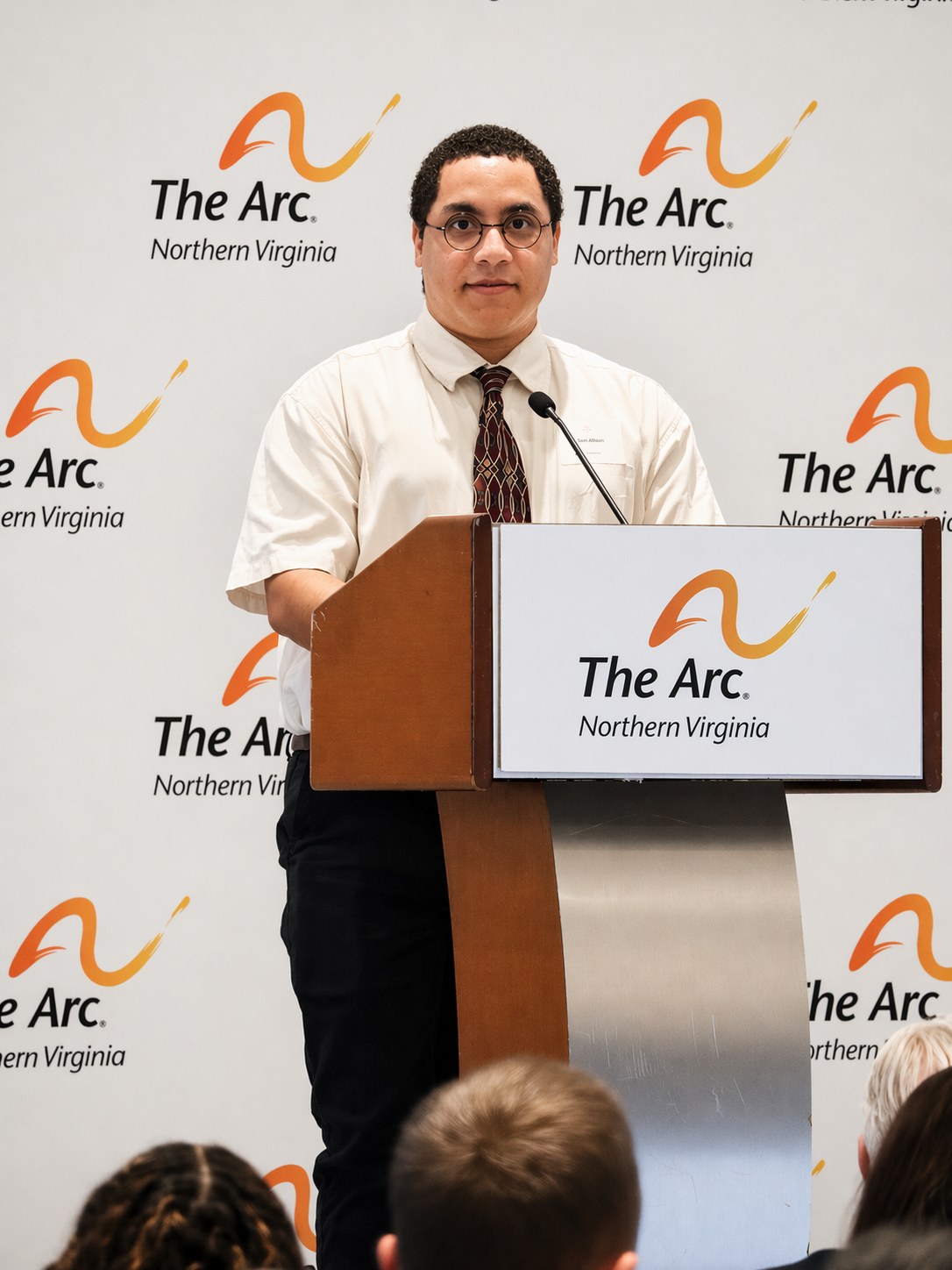
Ian Allan
Self-Advocate for The Arc of Northern Virginia