Introduction — The World That Refuses Stillness
There exists, within the contemporary condition, a form of exhaustion that resists immediate articulation. It does not always announce itself through rupture or collapse; more often, it emerges as a gradual attenuation of interior coherence, a thinning of attention, a fragmentation of presence, and an increasingly porous boundary between what is chosen and what is structurally imposed.
This phenomenon is not evenly distributed. Within disability communities, particularly among neurodivergent individuals, chronically ill populations, and those navigating fluctuating cognitive or sensory capacity, it is often intensified by the demand to continuously translate internal states into externally legible formats. The result is not only fatigue, but a secondary labor: the labor of explanation, justification, and adaptation.
In my own experience navigating administrative systems and disability advocacy structures, this dynamic is most visible in the subtle friction between embodied reality and institutional expectation. Meetings presume uninterrupted linear cognition.
Documentation systems presume stable recall and articulation. Professional environments frequently presume that attention is both abundant and uniformly distributable across time.
Yet lived experience rarely conforms to these assumptions.
The prevailing paradigm of modern life is structured around acceleration. Information circulates at velocities that exceed the human capacity for sustained integration.
Productivity is codified not merely as economic expectation but as moral orientation. Even rest is frequently subsumed into optimization logic, reframed as recovery for future output rather than as a legitimate state of being.
Within such a hegemonic structure, disabled embodiment is often rendered paradoxical: simultaneously present within systems that require participation, and yet structurally misaligned with the assumptions that underpin those systems. This produces what might be described as a persistent epistemic tension between what is experienced internally and what is recognized externally.
It is within this context that the metaphor of an “inner garden” becomes analytically useful.
Not as aesthetic abstraction, but as a conceptual model for ecological selfhood.
A garden is not static; it is responsive. It is shaped by weather, soil composition, invasive growth, and cycles of dormancy. It does not assume uniform productivity across time. It does not interpret variability as failure.
To maintain one’s peace, therefore, is not to stabilize the self into permanence. It is to engage in ongoing cultivation under conditions that are frequently indifferent—or structurally misaligned—to such cultivation.
Peace is not a possession.
It is a relational practice of return.
Soil — Inheritance, Institutional Conditioning, and Epistemic Constraint
Every garden is predicated upon soil that precedes intentional cultivation.
In phenomenological terms, soil is not merely “background”; it is the accumulated substrate through which perception itself is organized. It consists of early environmental conditions, institutional exposures, familial structures, and the often-unspoken codifications of what counts as “normal” cognition, communication, and affect.
Within disability contexts, this soil is frequently marked by a dual structure: care and constraint coexisting within the same environments. Support may be offered, but often within frameworks that require continuous self-translation. One learns not only how to communicate, but how to preempt miscommunication before it occurs. This produces a form of anticipatory cognition that is rarely named within institutional discourse.
In my own engagement with administrative systems and advocacy environments, I have repeatedly observed how institutional neutrality is often a form of disguised normativity. Policies framed as “standard procedure” frequently embed assumptions about attention span, sensory tolerance, cognitive sequencing, and emotional regulation that are not universally shared.
This is where the concept of soil becomes politically salient.
Soil is not neutral. It encodes what kinds of growth are expected, what kinds are tolerated, and what kinds are rendered unintelligible.
Disability justice frameworks, such as those articulated by Patty Berne, reframe interdependence as a foundational epistemology rather than an exception to independence. Similarly, Mia Mingus articulates “access intimacy” as a relational condition in which access is not continuously negotiated under pressure, but quietly understood through sustained attunement.
These frameworks reveal something crucial: access is not merely logistical. It is epistemic. It determines what kinds of experience are permitted to exist without constant translation.
Thus, soil is both an inheritance and an epistemic constraint. It is the condition through which the self becomes intelligible, or unintelligible, within dominant systems of meaning.
To tend soil, then, is not to “fix” it. It is to understand its composition well enough to no longer misinterpret its effects as personal deficiency.
Weeds — Internalized Systems, Masking Fatigue, and Adaptive Drift
Weeds are not anomalies within the inner garden. They are emergent growths shaped by environmental pressure.
In disability contexts, what is often labeled as “maladaptive” behavior frequently originates as an adaptive response. Masking, for example, is not inherently pathological; it is often a survival strategy developed within environments that reward conformity and penalize deviation.
However, when sustained over time, adaptive mechanisms begin to drift. What once served relational or institutional continuity becomes an internalized structure.
This produces what might be termed adaptive residue: patterns of cognition and affect that continue to operate even after the original conditions that necessitated them have changed.
In my own professional and relational experience, this is often visible in the form of anticipatory self-regulation; an ongoing internal calibration of speech, tone, pacing, and affect to align with perceived external expectation. While this can facilitate navigation of institutional environments, it also generates cumulative cognitive load that is rarely acknowledged within productivity discourse.
Weeds, therefore, are not “wrong growth.” They are overextended adaptation. They persist not because they are irrational, but because they were once necessary.
To tend them requires genealogical awareness: the capacity to trace present internal patterns back to their environmental origins without collapsing into moral interpretation.
This is a form of cognitive disentanglement rather than correction.
Seasons — Temporal Nonlinearity, Capacity Fluctuation, and Disabled Time
Dominant cultural paradigms privilege linear temporality. Progress is imagined as accumulation; productivity as continuity; coherence as uninterrupted output.
Yet within disabled and neurodivergent lived experience, temporality is often non-linear, cyclical, or discontinuous.
Capacity fluctuates not as an exception, but as a structure.
In my own navigation of professional responsibilities, advocacy commitments, and reflective work, I have observed that periods of high cognitive accessibility are often followed by periods of reduced processing capacity; not as regression, but as recalibration. These shifts are not easily accommodated by institutional timelines, which tend to assume stable output as the default condition.
This produces a structural mismatch between embodied time and bureaucratic time. The metaphor of seasons provides a corrective framework.
Seasons are not deviations from “proper” time. They are time expressed ecologically.
Winter is not the absence of life but the redistribution of activity beneath visible thresholds. Dormancy is not cessation but reorganization.
To interpret seasonal fluctuation as failure is to impose a normative temporal codification onto a non-normative system of being.
This reframing is not rhetorical. It is structural. It alters how one interprets capacity itself.
- Watering — Care Infrastructure, Burnout Avoidance, and Invisible Maintenance (Expanded)
Watering refers to the sustained, often unrecognized practices that maintain internal coherence over time.
Within disability justice discourse, care is not supplementary. It is infrastructural. Without it, participation becomes unstable; without it, continuity collapses.
In my own experience balancing administrative labor, advocacy engagement, and intellectual production, I have come to understand that sustainability is less about maximizing output and more about regulating input. This includes managing sensory environments, structuring cognitive load, and deliberately creating intervals of non-demand between tasks that require sustained attention.
One of the more under-discussed dimensions of this is invisible maintenance labor; the ongoing, unrecognized effort required simply to remain functional within environments that assume unbroken availability.
This includes recovery from overstimulation that is not acknowledged as such, decompression after sustained social or cognitive engagement, and the continuous recalibration of internal states to meet external expectations.
Watering is therefore not a metaphorical indulgence. It is a form of systemic maintenance that prevents collapse under conditions of structural overextension.
Sunlight — Attention, Epistemic Filtering, and Narrative Hegemony (Expanded)
Sunlight refers to attention as both a resource and a structuring mechanism.
Attention is shaped by narrative hegemony: the cultural frameworks that determine what is considered worthy of perception, interpretation, and emphasis.
Within ableist systems, attention is frequently directed toward deviation as a problem, productivity as a virtue, and rest as inefficiency. This creates a perceptual narrowing in which internal experience becomes filtered through deficit-oriented lenses.
In practice, this often results in what might be called epistemic compression; the reduction of complex internal states into simplified categories that are more legible within institutional or social frameworks.
To redirect sunlight is to engage in attentional ethics.
It is to consciously select what is permitted to shape internal architecture, and what is not.
Sunlight, then, is not merely illumination. It is governance of perception.
Pruning — Structural Limitation, Relational Loss, and Cognitive Release (Expanded)
Pruning is frequently misunderstood as removal. In ecological terms, it is structural adjustment.
Not all growth contributes to systemic sustainability. Some patterns, though once protective, become entangled in ways that inhibit further differentiation.
Within disabled experience, pruning is complicated by histories of scarcity, where access to care, stability, or understanding has been unevenly distributed. Under such conditions, letting go may feel structurally risky, even when cognitively necessary.
Yet pruning is not erasure. It is a reorganization.
It acknowledges that coherence requires limitation, and that limitation is not deprivation but form.
Conclusion — Toward a Relational Ecology of Peace (Expanded)
The inner garden is not an internal aesthetic metaphor. It is a relational ecology shaped by both personal history and structural condition.
To tend it is not to resolve it into stability, but to remain in continuous negotiation with its variability.
Across my work in disability advocacy, systems navigation, and organizational engagement, I have increasingly understood peace not as the absence of disruption, but as the capacity to re-establish coherence after disruption has occurred.
This capacity is never purely individual. It is distributed across networks of interdependence, accessibility structures, and relational forms of recognition that interrupt the isolating logic of normative expectation.
Peace, therefore, is not separable from interdependence. It is produced within it.
To tend the inner garden is to remain within this distributed ecology of care, where maintenance is not exceptional labor but ongoing relational practice.
It is not mastery. It is maintenance.
And within that maintenance, a quieter continuity becomes possible, one that does not require the self to remain unchanged to remain whole.
Note of Thanks
I extend acknowledgment to the disability justice communities, theorists, and organizers whose work continues to articulate interdependence as both a lived necessity and a political framework. In particular, the contributions of Patty Berne and Mia Mingus have been instrumental in shaping contemporary understandings of access, relationality, and embodied difference.
I also recognize the ongoing labor of disabled self-advocates, caregivers, and community organizers whose work often remains structurally underrecognized despite being foundational to the functioning of accessible life-worlds. Their contributions exist not as background context, but as active infrastructure within which any meaningful notion of inclusion must be situated.
Ian Allan
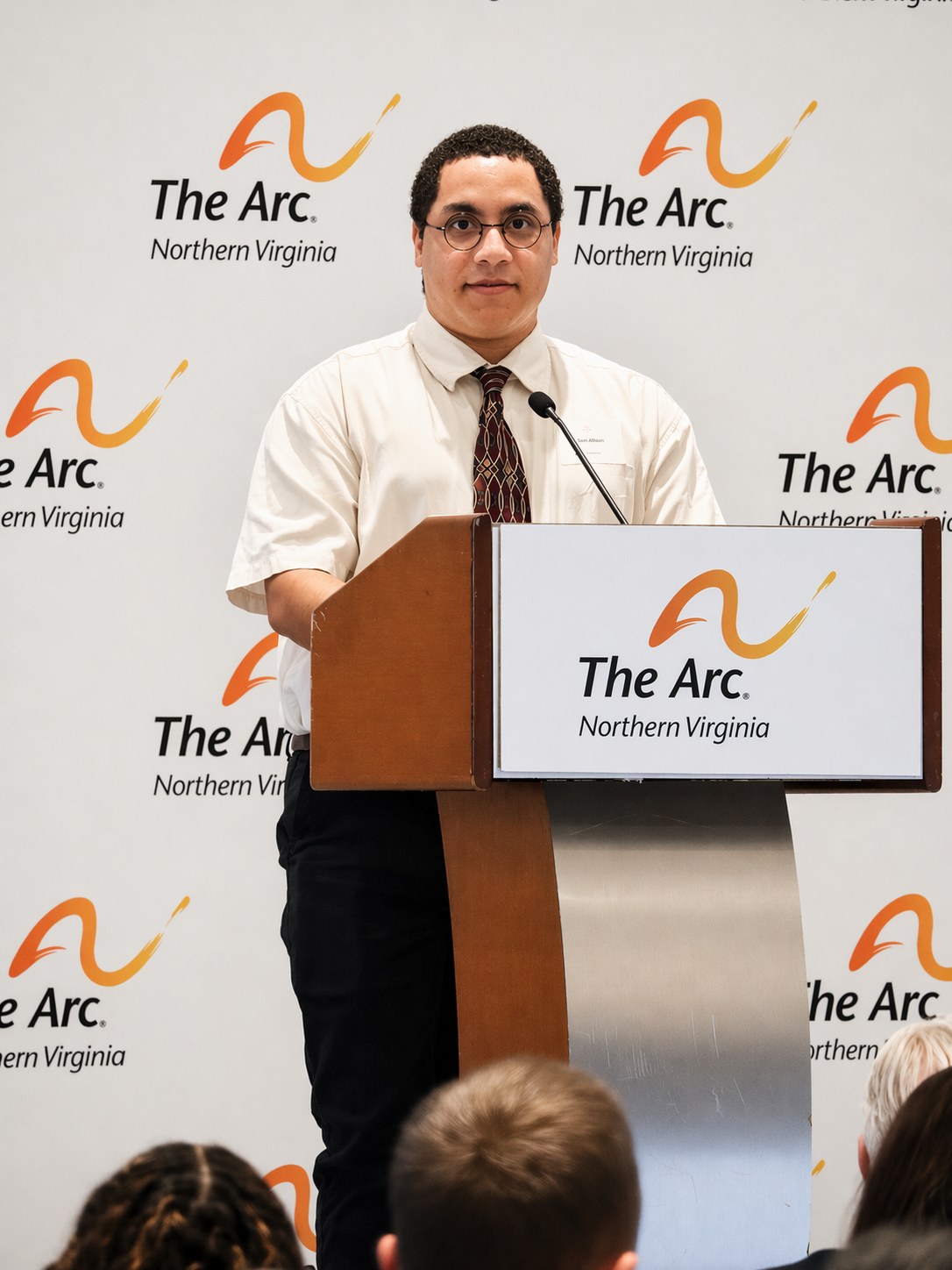
Self-Advocate for The Arc of Northern Virginia