The Conceptual Foundation: Spatial Exclusion as Disciplinary Paradigm
Hostile architecture, often reframed through the softened lexicon of “defensive design,” is frequently reduced to a matter of inconvenience, an aesthetic irritation embedded within the everyday. Yet such a reduction elides its deeper function. What is at stake is not merely discomfort, but codification: the embedding of social hierarchy into the material and sensory grammar of public space.
Within the framework of spatial justice, the built environment emerges not as a passive backdrop but as an active participant in the regulation of presence. It communicates quietly, persistently, who may remain, who must pass through, and who is rendered excess. These communications rarely announce themselves explicitly; rather, they reside in the interstices, where design and ideology converge to produce what can only be understood as a spatialized form of hegemony.
As a disability self-advocate, I have come to understand space not as something I simply occupy, but as something I must continually interpret. The question is rarely “Where can I go?” but rather “Under what conditions am I permitted to remain?” That distinction, subtle in phrasing, profound in implication, reveals the disciplinary nature of hostile design.
From a neurodivergent standpoint, this paradigm extends into the domain of sensory urbanism. The deployment of high-frequency deterrents, stark lighting, and acoustically abrasive environments constitutes a form of sensory governance. These are not incidental features; they are deliberate calibrations of experience. For those whose sensory thresholds diverge from the neurotypical norm, such calibrations do not merely
inconvenience; they exclude. The environment, in effect, performs a quiet sorting function.
The Taxonomy of Defensive Design: Physical and Atmospheric Hostility
Physical Barriers and the Restriction of Affordances
The physical manifestations of hostile architecture are often the most legible. Segmented benches, sloped surfaces, and anti-skate studs operate within the logic of affordance theory, delimiting what actions a body may perform within a given environment.
However, to describe these features as merely restrictive is to overlook their anticipatory quality. They do not simply respond to behavior; they preempt it. Rest is constrained before it can occur. Stillness is rendered suspect before it is enacted. In this sense, the environment does not react to the body; it disciplines it in advance.
In my own navigation of public space, this anticipatory design is often felt as a subtle but persistent negotiation. A bench is no longer an invitation to pause, but a question: Is this space meant for me in the way I need it? More often than not, the answer is already encoded into the structure itself.
Atmospheric Hostility and Sensory Regulation
If physical barriers constitute the visible architecture of exclusion, atmospheric interventions represent its more diffuse and, at times, more insidious extension. Here, hostility is not encountered as an object, but as an environment distributed across sound, light, and spatial complexity.
The use of high-decibel deterrents, disorienting visual fields, and strategically timed disruptions reflects a broader chronopolitics of governance not only of where one may be, but of how long one may remain without friction. For neurodivergent individuals, whose phenomenological engagement with sensory stimuli often exceeds normative thresholds, such environments produce a form of coerced mobility. One does not choose to leave; one is, in effect, compelled.
There is a particular exhaustion that emerges from this dynamic. It is not solely physical, but cognitive, an ongoing recalibration of attention, tolerance, and self-
regulation. In these moments, the environment ceases to be navigable in any meaningful sense. It becomes something to endure, or to exit.
Intersectional Intricacies: Disability Beyond Monolith
A critical analysis of hostile architecture must resist the flattening of disability into a singular category. The impacts of defensive design are unevenly distributed, mediated by distinct embodiments and compounded by broader social inequities.
- Mobility and Chronic Conditions: “Perch” seating and the erosion of accessible rest areas presume a body that can sustain itself indefinitely. For those with chronic pain or fatigue, this presumption transforms public participation into a calculus of endurance.
- Neurodivergence: Sensory-intensive environments, such as flickering lights, layered noise, and visual congestion, produce what might be described as phenomenological barriers. These are spaces that exist materially, yet remain experientially inaccessible.
- Psychosocial and Cognitive Disabilities: Non-linear layouts and ambiguous spatial cues disrupt orientation and autonomy, introducing friction where clarity should reside.
- Intersectional Poverty: The removal of public amenities such as restrooms and water sources disproportionately affects disabled individuals who are also unhoused. Here, hostile architecture converges with carceral urbanism, regulating not only behavior but survival itself.
What becomes evident is that exclusion is rarely singular in its operation. It is layered, cumulative, and often obscured by the very neutrality it claims.
The Paternalistic Paradox: Infantilization Under the Guise of Protection
Hostile architecture is seldom justified in explicit terms. Instead, it is framed through the rhetoric of safety, cleanliness, and order discourses that, upon closer examination, reveal a paternalistic underpinning.
The assertion that certain design features are necessary to “protect” the public or maintain communal standards often functions to obscure their exclusionary effects. Disabled individuals, among others, are positioned within this narrative as both vulnerable and disruptive subjects to be safeguarded, yet simultaneously managed.
This paradox produces a subtle form of infantilization, wherein autonomy is curtailed under the guise of care. The shift from inclusive design to defensive design is thus not merely technical, but ideological. It reflects a movement away from collective access and interdependence, toward a paradigm that privileges control, predictability, and normative embodiment.
Personal Intersections: A Situated Phenomenology of Navigating Space
My relationship to public space is neither abstract nor incidental; it is lived, iterative, and, at times, quietly contested.
Some moments resist immediate articulation: the hesitation before sitting, the recalibration of senses in an overstimulating environment, the awareness that what is designed as “public” may not, in practice, be accessible. These moments accumulate, forming a kind of experiential archive, a phenomenology of space that is shaped as much by exclusion as by presence.
In my work as a self-advocate, I often speak of systems policy frameworks, service infrastructures, and institutional barriers. Yet architecture operates at a different register. It does not argue; it imposes. It does not debate inclusion; it encodes it, or withholds it, at the level of design.
And yet, within this recognition lies a form of clarity. To name these dynamics is to disrupt their invisibility. To articulate how space disciplines the body is, in itself, an act of advocacy.
Synthesis and Advocacy: Toward Neuro-Cosmopolitanism and Crip Futurity
If hostile architecture represents the materialization of exclusion, then its transformation requires more than superficial revision. It demands a reconfiguration of the underlying paradigm.
The social model of disability offers a critical starting point, reframing disability as a function of environmental design rather than individual deficit. From this vantage, the question shifts: not how individuals might adapt to space, but how space must be reimagined to support a plurality of embodiments.
Emerging concepts such as neuro-cosmopolitanism gesture toward environments that accommodate diverse sensory and cognitive experiences not as an afterthought, but as a foundational principle. This aligns with the tenets of disability justice, which emphasize interdependence, collective access, and the dismantling of anti-ableist norms.
To move toward what is often termed crip futurity is to envision public space as an infrastructure of care rather than control. It is to recognize that accessibility is not a design constraint, but an expansion of its possibilities.
Such a shift is neither immediate nor uncomplicated. It requires sustained engagement across disciplines, communities, and systems of power. But it also begins, in quieter ways, with a willingness to see to perceive the geometries of exclusion that have long been rendered ordinary, and to imagine, with equal precision, what might take their place.
Note of Thanks
This work is shaped by the insights, labor, and lived experiences of the disability community; individuals and collectives whose advocacy continues to illuminate the often-unseen architectures of exclusion.
I extend my sincere gratitude to fellow self-advocates, organizers, and thinkers who advance the principles of interdependence, collective access, and disability justice in both visible and unrecognized ways. Their contributions challenge prevailing paradigms and make possible a more expansive, equitable vision of public space, one that does not merely accommodate difference, but is fundamentally reoriented by it.
Ian Allan
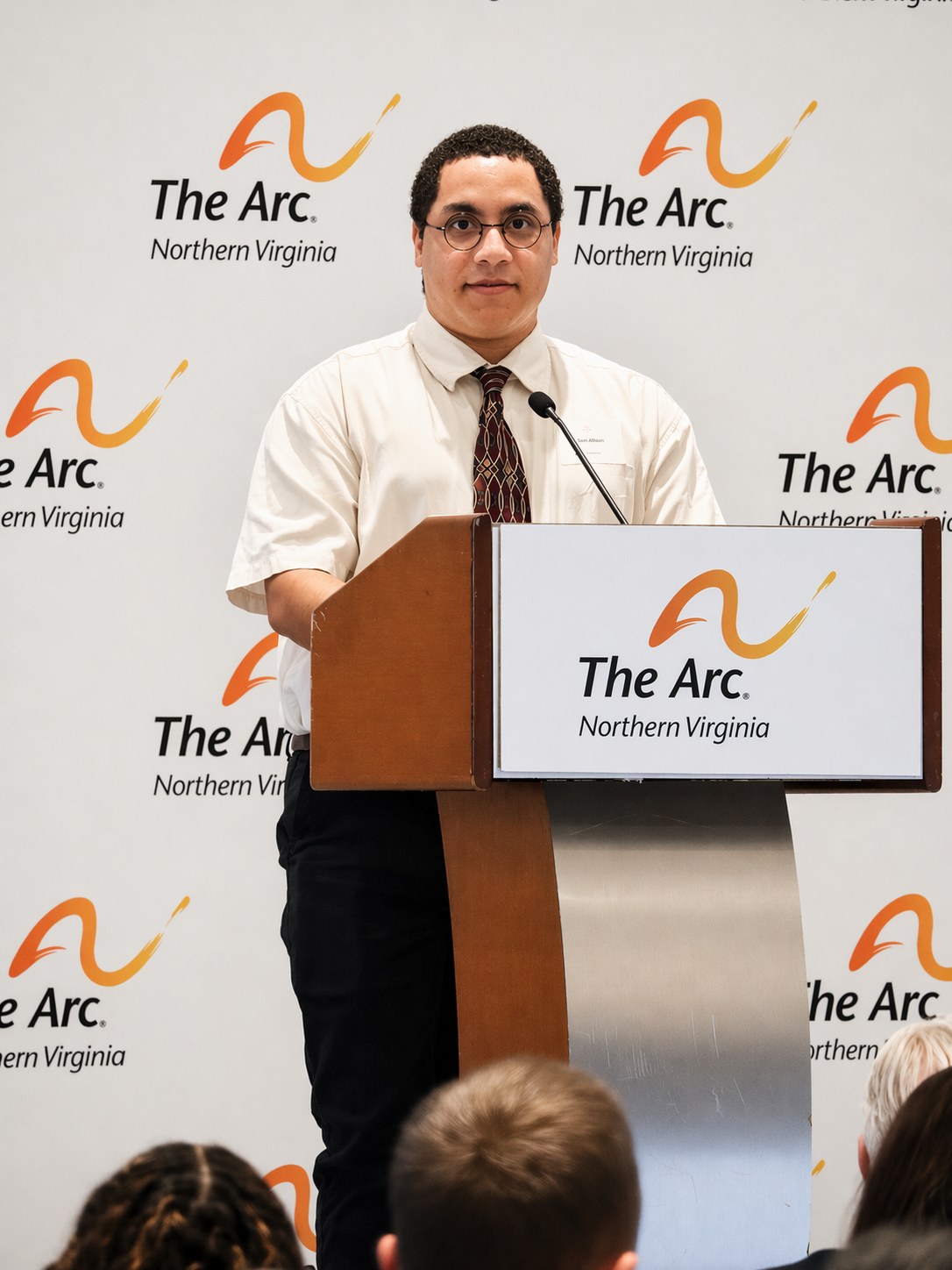
Self-Advocate for The Arc of Northern Virginia