Introduction: The Architecture of Separation
Among the innumerable provisions embedded within the Federal Acquisition Regulation system, FAR 52.222-21 — “Prohibition of Segregated Facilities” appears, at first glance, deceptively procedural. Its language is restrained, technical, and bureaucratically codified in the syntax characteristic of administrative governance. Yet beneath that administrative restraint lies a profound philosophical confrontation: namely, whether the spaces through which labor is organized will reinforce human hierarchy or resist it.
The clause emerged historically from the unfinished moral and institutional reckonings following legally sanctioned racial segregation in the United States. In practical terms, it prohibits federal contractors from maintaining segregated facilities based on race, color, religion, sex, sexual orientation, gender identity, or national origin. However, to interpret the clause solely through the lens of historical racial segregation would be to underestimate both its contemporary relevance and its latent analytical reach.
Segregation is not merely the existence of separate rooms, entrances, or facilities. It is the codification of differential belonging. It is the transformation of social hierarchy into physical infrastructure. It is the conversion of exclusion into architecture.
And within the disabled community, particularly among neurodivergent individuals whose experiences often exist within the interstices of visibility and institutional recognition. Segregation frequently re-emerges in forms that evade formal designation while preserving identical outcomes.
The modern workplace rarely announces exclusion explicitly. Rather, exclusion increasingly manifests through organizational paradigms that privilege neurotypical communication norms, sensory tolerance thresholds, productivity expectations, and social performativity. The result is not always overt segregation in the historical sense, but something arguably more elusive: the normalization of inaccessible participation masquerading as neutrality.
Thus, the significance of FAR 52.222-21 extends beyond compliance doctrine. It invites a broader inquiry into how institutions organize proximity, legitimacy, participation, and human value itself.
The Core Requirement: What FAR 52.222-21 Actually Prohibits
At its heart, FAR 52.222-21 mandates that federal contractors ensure facilities are provided in a manner that does not result in segregation on protected grounds.
The clause applies broadly to spaces associated with employment and institutional participation, including:
- Waiting rooms and workspaces.
- Restaurants and eating areas.
- Restrooms and locker rooms.
- Parking facilities and transportation.
- Housing provided to employees.
- Drinking fountains and shared facilities.
Importantly, the regulation prohibits segregation regardless of whether it arises through explicit policy, implicit custom, or de facto organizational arrangement.
This distinction matters immensely.
Historically, segregation often depended not solely upon written law, but upon institutional habituation, a social phenomenology in which exclusion became self-reinforcing precisely because it was normalized. In this regard, FAR 52.222-21 recognizes a critical reality frequently overlooked within contemporary governance
frameworks: systems of exclusion persist even when institutions cease articulating them openly.
The clause, therefore, functions not merely as a prohibition against discriminatory intent, but as an acknowledgment that infrastructure itself can become ideological.
Segregation Beyond Walls: Disability, Neurotypical Hegemony, and Invisible Partitioning
Although disability is not explicitly enumerated within FAR 52.222-21 itself, the clause nonetheless raises urgent analytical questions regarding the organization of accessibility and belonging within federal contracting environments.
For many disabled individuals, segregation no longer appears primarily through separate facilities. Instead, it manifests through environmental design paradigms that assume neurotypicality, sensory conformity, and standardized communicative behavior as universal defaults.
The consequences of this are profound.
A workplace may technically permit disabled participation while simultaneously constructing conditions under which meaningful inclusion becomes structurally unattainable. Inaccessible lighting, unyielding productivity metrics, compulsory social performance, inflexible communication expectations, and the stigmatization of accommodation requests collectively produce what may be understood as functional segregation.
This form of segregation often operates beneath institutional consciousness. The employee is present, yet peripheral.
Included, yet untranslated.
Physically integrated, yet phenomenologically isolated.
In many professional settings, neurodivergent individuals learn quickly that access is tolerated only insofar as it does not disrupt dominant behavioral norms. The burden, therefore, shifts away from institutions and onto disabled individuals themselves, who are frequently expected to approximate neurotypical modes of interaction to secure legitimacy.
Such expectations reveal the persistence of neurotypical hegemony within organizational culture.
The issue is not merely whether disabled individuals are allowed to enter institutional spaces. The deeper question is whether those spaces were conceptually designed with disabled existence in mind at all.
Equal Opportunity and the Materiality of Space
FAR 52.222-21 operates alongside Executive Order 11246 and FAR 52.222-26, Equal Opportunity, forming part of a broader anti-discrimination framework governing federal contractors.
What distinguishes FAR 52.222-21, however, is its emphasis on the material environment rather than solely on hiring practices.
This distinction is philosophically significant.
Equal opportunity cannot exist in any substantive sense if institutional geography itself reproduces hierarchy. A workplace may advertise diversity initiatives while simultaneously maintaining inaccessible sensory environments, culturally exclusionary social norms, or infrastructural conditions that implicitly stratify employees according to perceived normalcy.
The physical environment is never ideologically neutral.
Every institutional design decision communicates assumptions about who is anticipated, accommodated, and valued. Every unexamined norm carries epistemological weight. Every inaccessible structure reveals a prior imagination of whose body or cognition was considered standard during the design process.
From a disability justice perspective, this transforms accessibility from a matter of individualized accommodation into a question of collective architectural ethics.
The paradigm shifts from:
“How do we adapt disabled individuals to institutions?” to:
“How do institutions evolve beyond ableist assumptions altogether?”
That distinction marks the difference between compliance and transformation.
Contractor Responsibilities and the Ethics of Institutional Stewardship
Federal contractors subject to FAR 52.222-21 must certify that they neither maintain nor permit segregated facilities. Additionally, the clause contains a mandatory “flow-down” requirement obligating contractors to incorporate the provision into qualifying subcontracts.
Legally, this ensures that anti-segregation principles permeate contractual hierarchies rather than terminating at the primary contractor level.
Philosophically, however, the flow-down requirement suggests something larger: that ethical responsibility cannot remain localized within symbolic leadership structures while exclusion proliferates downstream.
Institutional ethics are tested not through mission statements, but through operational diffusion.
A company may articulate commitments to inclusion publicly while subcontracting labor into inaccessible or exploitative environments privately. FAR 52.222-21 attempts, however imperfectly, to prevent such compartmentalization.
Yet the disabled community frequently encounters another complication altogether, namely, the tension between formal compliance and lived accessibility.
An institution may satisfy regulatory minimums while preserving cultures of informal exclusion. This discrepancy reveals a recurring limitation within anti-discrimination law generally: legality alone cannot fully dismantle social hierarchy when organizational norms continue to privilege assimilation over interdependence.
True collective access requires more than procedural accommodation. It requires a reorientation of institutional imagination itself.
The Interstices of Compliance: Where Law and Lived Experience Diverge
There exists a persistent tendency within administrative systems to confuse codification with resolution.
Once a prohibition has been formally articulated, institutions often assume the underlying problem has been meaningfully addressed. Yet disabled individuals, particularly neurodivergent workers, frequently experience a profound disjunction between formal protections and practical realities.
This disjunction exists within the interstices between policy language and organizational culture.
A workplace may technically prohibit segregation while socially penalizing difference. It may provide accommodations while stigmatizing their use.
It may celebrate diversity rhetorically while rewarding only those capable of replicating dominant behavioral norms.
These contradictions matter because exclusion increasingly survives through subtle mechanisms rather than overt declarations.
Indeed, some of the most enduring forms of segregation are those rendered socially invisible through normalization.
From a personal standpoint, this dynamic is difficult to ignore. As someone who has navigated institutional environments while neurodivergent, I have often observed how accessibility is frequently conceptualized as an exception rather than an organizing principle. One learns, sometimes quietly and over many years, that inclusion can remain conditional upon one’s ability to minimize perceived disruption.
The psychological consequence of this condition is not always dramatic exclusion. More often, it is chronic translation, the continuous labor of rendering oneself legible within systems calibrated around neurotypical expectations.
That labor, though rarely acknowledged institutionally, is itself a form of structural burden.
Disability Justice, Collective Access, and the Limits of Assimilation
Disability justice frameworks complicate conventional understandings of workplace inclusion by rejecting the assumption that disabled individuals alone bear responsibility for adaptation.
Instead, disability justice emphasizes:
- Interdependence rather than hyper-individualized productivity.
- Collective access rather than individualized exception-making.
- Anti-ableist organizational norms rather than performative accommodation.
- Structural redesign rather than symbolic inclusion.
Within this framework, the prohibition of segregated facilities acquires renewed relevance.
Segregation is not merely physical partitioning. It is any organizational arrangement that systematically conditions participation upon conformity to dominant norms.
A sensory-hostile workplace can segregate.
An inflexible communication culture can segregate.
A productivity paradigm that pathologizes cognitive variance can segregate.
And perhaps most significantly, institutions can segregate without ever recognizing themselves as exclusionary.
This is why disability justice movements increasingly challenge not only discriminatory acts, but the foundational paradigms through which competence, professionalism, and legitimacy are socially constructed.
The issue is not whether disabled individuals can survive institutional systems.
The issue is whether institutional systems can evolve beyond ableist premises altogether.
Conclusion: Against the Normalization of Invisible Separation
FAR 52.222-21 may appear narrow in administrative scope, yet its implications extend far beyond federal procurement compliance.
At its deepest level, the clause confronts an enduring political and philosophical question: what kinds of separation become normalized when institutions are permitted to organize human difference hierarchically?
The answer is rarely confined to physical walls. Segregation persists wherever access is conditional.
Where participation requires assimilation.
Where dignity is distributed unevenly according to proximity to dominant norms.
And within contemporary workplaces, particularly for disabled and neurodivergent individuals, these forms of invisible partitioning often survive beneath the rhetoric of inclusion itself.
To interrogate FAR 52.222-21 critically, therefore, is not simply to examine a procurement regulation. It is to examine the phenomenology of institutional belonging, the ways systems decide who is anticipated, who is accommodated, and who remains perpetually adjacent to legitimacy without fully possessing it.
The prohibition of segregated facilities is thus not merely a legal mandate. It is an unfinished ethical proposition.
One that asks whether access will remain conditional, or whether institutions may yet move toward a paradigm rooted in collective dignity, interdependence, and genuinely shared human presence.
Note of Thanks
I would like to extend my sincere gratitude to the disability advocates, scholars, federal workers, educators, and community members whose continued labor, often rendered invisible within institutional discourse, has contributed to broader conversations surrounding accessibility, anti-ableist practice, and collective access.
Particular appreciation is owed to those within the disabled and neurodivergent communities who continue articulating experiences that exist within the margins of formal policy language, yet remain central to understanding how exclusion operates in lived reality.
Their insights continue to illuminate the distance between compliance and belonging, and in doing so, expand the possibilities of what institutional dignity might yet become.
Ian Allan
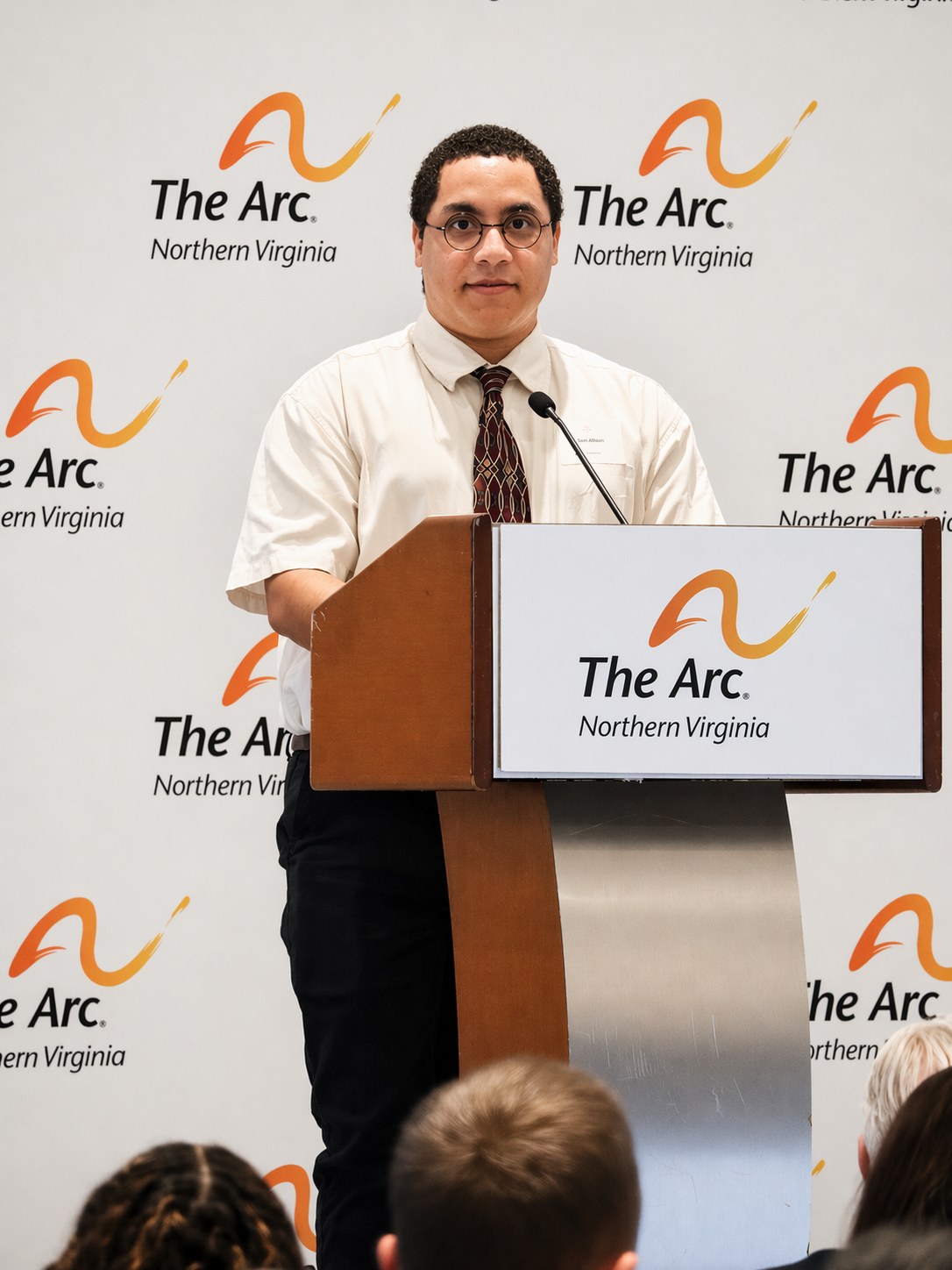
Self-Advocate for The Arc of Northern Virginia