“I remember the day a professor told me, flatly, that ‘if you can’t meet the prerequisite the way it’s written, you don’t belong in the course.’ There was no discussion about accommodations. No curiosity about how I might engage differently. Just a locked door labeled ‘standard.’ At that moment, I wasn’t a learner. I was an exception they didn’t want to make.”
Introduction: The Locked Door
I remember sitting across from a department advisor, clutching a thick folder of documentation, psych evals, and IEP records, letters from doctors, all in hopes that it would be enough to justify what I was asking for: a chance to meet the prerequisite for a class, but with accommodations. The advisor barely glanced at it. “If you can’t meet the requirement as written,” she said, “then maybe this field just isn’t for you.”
It wasn’t said with cruelty. It was said with finality, as if the rules themselves had spoken. And in that moment, the conversation shifted from one about academic preparation to one about belonging.
For many disabled students, this moment is painfully familiar. It’s the point at which policy becomes a barrier rather than a bridge. Prerequisites, meant to ensure readiness, are too often treated as rigid gatekeepers; interpreted in ways that exclude rather than adapt, that uphold a narrow definition of capability instead of making space for diverse ways of learning and knowing.
What if honoring prerequisites didn’t mean enforcing a single path to competency, but honoring the variety of ways students can demonstrate it? What if higher education stopped viewing accommodations as exceptions and began seeing them as part of the academic landscape?
This essay is not just a call for legal compliance; it is a call for educational integrity rooted in justice. Because when we honor prerequisites in ways that include disabled students, we’re not lowering standards. We’re raising them for everyone.
The Myth of the “Standard” Student
Higher education has long operated on the unspoken assumption of a “standard” student; one who moves through coursework at a predictable pace, absorbs information through lectures and textbooks, and demonstrates mastery through timed exams and formal essays. This archetype is rarely questioned, yet it shapes everything from course design to academic advising to the prerequisites that determine who gets access to what.
But here’s the truth: the “standard” student doesn’t exist.
Students arrive at college from a kaleidoscope of backgrounds, with different ways of processing information, different life experiences, and different needs. Some live with chronic illness or mental health conditions that make energy unpredictable. Others use assistive technology to read or write. Still others, especially those with invisible disabilities, are navigating institutions that were never built with them in mind.
Prerequisites, when interpreted narrowly, often reinforce this myth. They assume that competence looks the same for everyone, or that mastery must be demonstrated through a single, able-bodied, neurotypical modality. A math prerequisite might be satisfied by passing a standardized test, but what about the student with dyscalculia who could thrive in the conceptual aspects of a science major with the right support? A reading-heavy prerequisite might exclude someone who processes text auditorily but comprehends and analyzes at a high level when given access.
The problem is not with the idea of prerequisites themselves; it’s with the rigid, ableist ways they are enforced. When we conflate sameness with fairness, we mistake exclusion for academic rigor.
In reality, true academic rigor lies in recognizing the diversity of learners and making room for multiple pathways to success. Holding disabled students to high standards does not mean forcing them to fit a mold; it means expanding our definitions of what preparedness, capability, and brilliance can look like.
Compliance vs. Commitment
When institutions talk about disability, the conversation often begins and ends with compliance. Are we meeting the minimum legal standards? Are we providing the required accommodations? Is our paperwork in order?
But compliance is not commitment.
The Americans with Disabilities Act (ADA) was a landmark victory, but it was never meant to be the ceiling of what’s possible; it was meant to be the floor. It establishes a baseline of accessibility, but it cannot, on its own, produce a culture of belonging. When institutions view accommodations as boxes to check, they miss the deeper work of reimagining education in a way that truly includes disabled students from the ground up.
Too often, accommodations are framed as special privileges or burdensome exceptions rather than as tools for equity. A student requesting extra time on exams or alternative format textbooks may be met with suspicion or delay, forced to repeatedly justify their needs to a system built without them in mind. And when it comes to prerequisites, the rigidity with which they are enforced can override any flexibility the ADA was meant to ensure.
There’s a profound difference between saying, “We’ll make an exception for you,” and saying, “You belong here, and we will support you.” One is begrudging tolerance. The other is structural inclusion.
Commitment means designing courses with accessibility in mind from the beginning. It means training faculty to recognize disability as a form of diversity, not as a disruption. It means listening to disabled students not just when they file grievances, but when they speak about what excellence looks like on their terms.
Without commitment, compliance becomes performative; a façade of equality that leaves structural inequality untouched. But when institutions move beyond compliance and lean into a vision of inclusive education, honoring prerequisites becomes an act of respect, not resistance.
The Purpose of Prerequisites
At their best, prerequisites serve an important function. They help ensure that students are equipped with the foundational knowledge or skills necessary to succeed in more advanced coursework. They’re not meant to be arbitrary roadblocks; they’re meant to be stepping stones.
But like any tool, prerequisites can be misused.
When institutions apply prerequisites without flexibility or imagination, they risk turning what should be a scaffold into a gate. The question becomes not “Has this student demonstrated readiness?” but “Has this student followed the same path as everyone else?” And for disabled students, whose paths often involve adaptations, alternate methods, or creative approaches, that question can be both exclusionary and absurd.
Consider a student with a learning disability who demonstrates conceptual mastery through oral discussion but struggles with high-stakes written exams. Or a student who uses screen readers and needs extended time to process written material, but has already excelled in similar content outside the traditional classroom. Should they be denied entry into a course simply because their prior achievements don’t fit neatly into a checkbox?
Honoring prerequisites for disabled students doesn’t mean watering down standards. It means holding all students to equitable standards; standards that allow for different ways of reaching the same academic goal. This could involve substituting a traditional prerequisite with a demonstrable competency, allowing modified pathways to show readiness, or integrating accommodations directly into prerequisite evaluation processes.
This approach aligns with the spirit of Universal Design for Learning (UDL), which encourages instructors to offer multiple means of representation, engagement, and expression. UDL doesn’t ask who the “standard student” is; it asks how the learning environment can flex to accommodate the full range of human variation.
When prerequisites are framed around outcomes instead of narrow methods, they do exactly what they were designed to do: prepare students for success. The difference is, they do so without erasing the diversity of ways people learn, communicate, and thrive.
Intersectionality and Structural Inequities
To talk about access without talking about power is to miss the point.
Disability does not operate in a vacuum. It intersects with race, class, gender, language, and other aspects of identity, often in ways that intensify marginalization. A disabled student who is also a first-generation college student, or who comes from a low-income background, or who is Black, Brown, or Hispanic, is not just navigating one barrier at a time. They are navigating a layered architecture of exclusion, where the failure to honor
prerequisites with equity can become the final straw in a long chain of academic gatekeeping.
Take, for example, the bureaucratic demands of securing accommodations: medical documentation, testing, and formal diagnoses, all of which require time, money, and access to healthcare. For many disabled students of color or those from working-class communities, these prerequisites to the prerequisites are themselves forms of structural violence. They create invisible walls that keep people out, long before they even reach the classroom door.
Then there’s the cultural dimension: the assumption that all students feel empowered to self-advocate, to speak the language of academia, to challenge authority respectfully while still being taken seriously. But for students who already carry the weight of being “othered,” asking for accommodations or for prerequisite exceptions can feel like risking one’s legitimacy altogether.
When institutions fail to consider these intersections, they reinforce inequality under the guise of neutrality. They treat all students as if they are beginning from the same place, with the same resources, when in truth, some students have been running uphill their entire academic lives.
Honoring prerequisites through an intersectional lens means understanding that equal treatment is not the same as equitable opportunity. It means designing systems that are not only accessible in theory but navigable in practice. It means listening to the voices of disabled students at the margins, especially those whose experiences are shaped by racism, xenophobia, misogyny, transphobia, or poverty; and trusting that their insight is not anecdotal but structural.
If we want higher education to be a site of transformation and justice, we cannot afford to address disability rights without also addressing the full ecosystem of oppression in which those rights are either upheld or denied.
Toward a Culture of Academic Belonging
At the heart of higher education lies a promise: that learning can change lives. But for that promise to be fulfilled, institutions must evolve from being merely accessible to being places where all students truly belong.
Belonging is not something that happens when a student proves they can survive a system that wasn’t built for them. It happens when the system itself is transformed,
when policies, curricula, and campus cultures reflect the full diversity of those they serve. It happens when disabled students are not simply accommodated, but welcomed as innovators, leaders, and co-creators of academic life.
To build this culture of belonging, institutions must rethink what it means to “honor” prerequisites. Honoring is not just enforcing them; it’s recognizing their intent and then applying them through a lens of flexibility, care, and justice. It’s saying: We see your potential, and we trust your knowledge, even if it arrived by a different road.
This shift requires more than individual accommodations; it requires systemic redesign. It means implementing proactive accessibility practices from the syllabus to graduation requirements. It means faculty development that centers disability as a vital part of diversity. It means partnership with disabled students, not just consultation. And it means ongoing reflection: not “How little can we do to comply?” but “How much can we do to uplift?”
We must also move beyond narratives of pity or heroism. Disabled students are not inspirational for simply existing within exclusionary systems. Nor are they problems to be solved. They are experts in adaptation, resilience, and creative problem-solving, qualities any institution should value.
Ultimately, creating a culture of academic belonging benefits everyone. When we expand the definition of preparedness, when we build in flexibility without sacrificing standards, we don’t lower the bar; we build a wider bridge. And in doing so, we make higher education not only more inclusive but also more human.
Conclusion
Honoring the prerequisites for students with disabilities is to honor the reality that learning is not one-size-fits-all. It is to affirm that rigor and compassion are not opposites, and that inclusion is not charity; it is justice.
The Americans with Disabilities Act laid the groundwork, but it is the responsibility of every institution to build on that foundation with intention, creativity, and care.
Prerequisites, like all aspects of academia, should be tools for empowerment, not instruments of exclusion. And honoring them should never mean forcing disabled students to contort themselves to fit narrow molds, but rather expanding our vision of what preparedness, success, and belonging can look like.
True educational equity demands more than compliance. It demands commitment. It demands imagination. And it demands that we listen to the voices of those most affected, not as an afterthought, but as architects of the very systems they are navigating.
Because when we build learning environments with disabled students in mind from the beginning, we don’t just create access, we create excellence. We create futures.
And most importantly, we create a world in which no one has to earn their right to be included.
Author’s Note
This essay is not a provocation, nor is it meant to cast blame or invite discord. Rather, it is an appeal for awareness, for reflection, and above all, for change.
I write from lived experience, and I know I am not alone. Many in the disability community have encountered similar barriers in their pursuit of higher education; barriers that are often invisible to those who have never had to navigate them. The opportunities offered may appear promising on the surface, but too often they fall short of preparing us for the structural realities that await.
I hope that this piece will open space for deeper, more honest conversations across institutions, disciplines, and identities. Conversations where we do not assume sameness, but instead embrace the complexity of what it truly means to make education accessible, equitable, and empowering for all.
We deserve more than inclusion in name. We deserve belonging in practice.
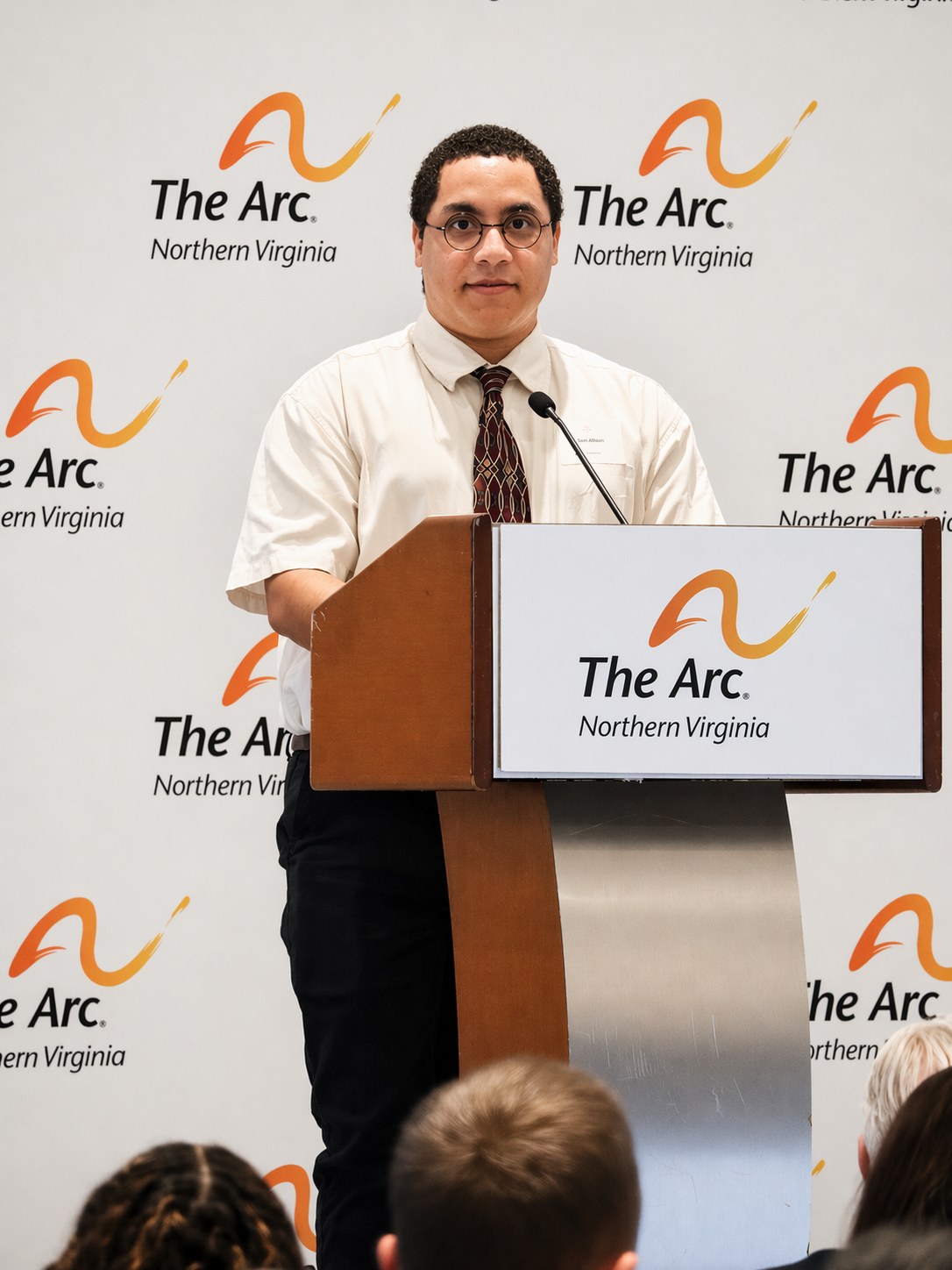
Ian Allan
Self-Advocate for The Arc of Northern Virginia