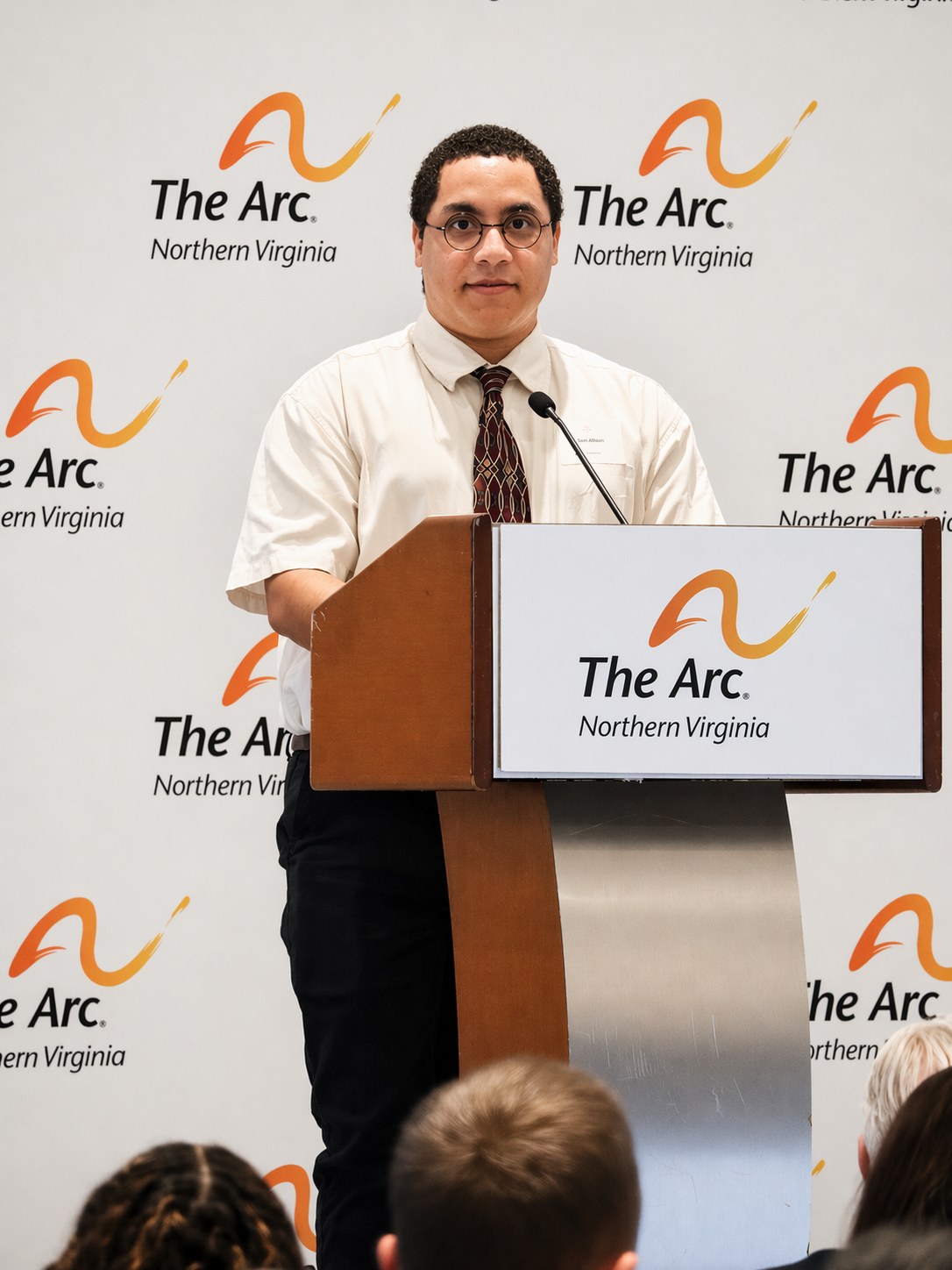
When I am introduced at disability inclusion events, the framing is often familiar: “We must include individuals like Ian in these conversations.”
It is usually said warmly, even earnestly. But over time, I’ve learned to hear what sits beneath the phrasing: inclusion as presence, not participation; visibility, not authority.
The question I find myself returning to is simple,yet uncomfortable for many institutions to answer honestly:
Inclusion That Stops at the Doorway
As a neurodivergent professional and disability rights advocate, I have spent years working within and alongside systems that shape disability policy and services. I currently support individuals and families navigating Medicaid waivers, Individualized Education Programs (IEPs), and other complex administrative structures through my work with The Arc of Northern Virginia. I also co-founded From the Self-Advocate’s Desk, an initiative intended to ensure that disabled people are not just referenced in decision-making spaces, but embedded within them.
Yet despite this work, I often encounter a recurring pattern: inclusion that is conditional on visibility, but not on influence.
Disabled people are invited to speak on panels, contribute stories, and appear in organizational narratives. Far less often are we invited into the spaces where decisions are actually made.
This is the distinction that matters: participation without power is not inclusion.
The Comfortable Distance of Tokenism
Much of modern disability inclusion exists in this in-between space, well-intentioned but structurally incomplete.
Research from organizations such as the National Disability Institute has shown that while many institutions articulate commitments to inclusion, far fewer implement structural changes that transfer real decision-making authority to disabled people. In practice, this produces a familiar outcome: disabled individuals are brought in for visibility and legitimacy, but rarely positioned as equal contributors to governance or strategy.
Tokenism is rarely explicit. It is not usually malicious. It is often procedural.
But its effects are consistent: disabled people are asked to represent experience, but not shape systems.
We are present in photos, panels, and awareness campaigns. We are far less present in budgets, leadership structures, and policy design.
More Than a Diagnosis, More Than a Narrative
My identity is often summarized in narrow terms: I am neurodivergent, autistic, and have a mild intellectual disability. Those descriptors are real, but incomplete.
They do not capture the scope of my professional experience or the nature of my work.
In my role with The Arc of Northern Virginia, I assist individuals and families navigating systems that are often opaque and exhausting: Medicaid waivers, education plans, and service eligibility processes that determine access to fundamental supports. These are not abstract policy debates; they are lived infrastructures that shape whether people receive care, education, and stability.
Beyond that, I co-founded From the Self-Advocate’s Desk to ensure that disabled individuals are not simply subjects of discussion but contributors to institutional knowledge. My work regularly intersects with educators, public administrators, and government stakeholders focused on improving accessibility and equity in practice, not just in principle.
Yet even with this experience, I have been interrupted in meetings where I served as co-facilitator, spoken over in professional settings, and praised for participation rather than recognized for contribution.
The pattern is subtle, but persistent: competence is often reinterpreted through the lens of assumption rather than evidence.
The Structural Underestimation of Disabled Expertise
Neurodivergent professionals are frequently placed in a paradoxical position.
We are invited to speak about inclusion, but not always treated as included in expertise. We are asked to share lived experience, but not always granted the credibility afforded to others in the same room.
This dynamic reflects a broader societal assumption: that disability primarily produces limitation rather than knowledge.
But lived experience is not supplemental to expertise; it is a form of expertise.
It is precisely this knowledge that allows disabled people to navigate systems that were not designed with us in mind. It is what enables us to identify friction points in policy, gaps in accessibility, and failures in institutional design that are otherwise invisible to those who do not live within them.
To exclude that knowledge from decision-making is not neutral; it is structurally costly.
Representation Without Power Is Not Progress
Disability inclusion has become increasingly visible in public discourse. Autism, ADHD, and other neurodivergent identities are more widely discussed than in previous decades. Social media has amplified disabled voices in important ways, allowing self-advocacy to reach broader audiences without institutional gatekeeping.
And yet, visibility alone does not guarantee structural change.
Too often, representation is still mediated, filtered through institutions, organizations, or non-disabled spokespersons who frame disability rather than participate in it.
This creates a persistent gap between who is seen and who is heard.
As disability rights advocates such as Alice Wong and Lydia X. Z. Brown have emphasized, “nothing about us without us” is not simply a slogan. It is a governance principle. It demands that disabled people are not only consulted, but embedded within the structures that make decisions.
Without that shift, inclusion risks becoming symbolic performance rather than systemic transformation.
What Meaningful Inclusion Actually Requires
If institutions are serious about inclusion, the standard must change.
It is no longer sufficient to invite disabled speakers onto panels while excluding them from leadership pipelines. It is no longer sufficient to highlight disability awareness while leaving decision-making structures unchanged.
Meaningful inclusion requires concrete questions:
- Do disabled people have decision-making authority, or only advisory roles?
- Are neurodivergent professionals compensated equitably for their expertise?
- Are disabled voices shaping policy, or being asked to validate pre-existing decisions?
These are not rhetorical questions. They are structural ones.
Organizations such as the Autistic Self Advocacy Network (ASAN), the National Council on Independent Living (NCIL), and the Disability Visibility Project already demonstrate what disability-led leadership looks like in practice. They are not symbolic spaces; they are operational ones, built on the principle that disabled people are not subjects of advocacy, but authors of it.
Institutions seeking to improve inclusion do not need to reinvent this framework, they need to follow it.
Beyond Inclusion as Performance
I do not question the intent of those who extend invitations to disabled speakers, panelists, or contributors. Many are genuinely committed to equity.
But intent is not the same as structure.
And without structural change, inclusion risks becoming a well-meaning performance; one that celebrates presence while preserving hierarchy.
Neurodivergent individuals are already leading, organizing, and building across every sector imaginable. What remains uneven is not capacity, but access to influence.
The question, then, is not whether disabled people can contribute meaningfully. That answer is already visible in practice.
The question is whether institutions are willing to recognize that contribution as authoritative and to share power accordingly.
A Closing Imperative
Neurodivergent people do not need to be made visible. We already are.
What we need is to be taken seriously, not as symbols of inclusion, but as participants in governance, design, and leadership.
Until that shift occurs, inclusion will remain incomplete: visible, but not transformative; present, but not powerful.
And for those of us asked to represent inclusion in spaces we do not fully shape, the underlying question will remain.
Ian Allan
Self-Advocate for The Arc of Northern Virginia