Introduction: The Movement We Assume Is Effortless
There is an unspoken assumption embedded within the fabric of everyday life: that movement is universal, intuitive, and equally accessible to all bodies. From the moment individuals begin navigating the world around them, society establishes expectations regarding how people should move, respond, organize, and interact. The body is often viewed as a reliable instrument, one that receives intention and effortlessly transforms thought into action.
Yet beneath this assumption exists an extraordinarily complex neurological process.
A simple action such as writing a sentence, fastening clothing, preparing a meal, navigating a crowded hallway, or learning a new physical skill requires intricate coordination between cognition, sensory interpretation, motor planning, memory, and environmental awareness. These processes often remain unnoticed precisely because, for many individuals, they occur without conscious deliberation. The complexity disappears beneath the appearance of effortlessness.
However, for individuals with dyspraxia, this relationship between thought and movement may operate differently.
The difficulty is not necessarily that movement does not occur. Rather, the pathway between intention and execution may require additional processing, adaptation, and conscious effort. What others may perceive as automatic may instead represent a carefully managed interaction between neurological processing and the physical environment.
This distinction is essential because dyspraxia has often been misunderstood through a narrow interpretation of ability. The conversation surrounding motor coordination differences frequently centers on what an individual cannot do rather than examining the broader reality of how individuals adapt, problem-solve, and navigate environments that were not always designed with neurological diversity in mind.
Dyspraxia exists within a complicated intersection between embodiment, identity, and social expectation. While commonly associated with challenges involving coordination and motor skills, its influence can extend into education, employment, communication, sensory experiences, organization, and daily living. Yet the most significant barriers experienced by many individuals with dyspraxia are not always created by the neurological difference itself. They are often produced through societal assumptions about what competence, independence, and capability are expected to look like.
Modern society frequently operates within a narrow paradigm of human performance. Speed is often interpreted as efficiency. Precision is often interpreted as responsibility. Physical coordination is often interpreted as competence. Independence is frequently elevated as the ultimate measure of success.
Within this framework, individuals who move, process, or interact differently may find themselves evaluated against standards that were never designed to account for neurological variation.
This creates a profound contradiction.
A society may claim to value diversity while simultaneously maintaining systems that reward conformity. It may celebrate individuality while preserving institutional structures that define a singular version of acceptable functioning. It may encourage inclusion while continuing to rely upon assumptions that position difference as an obstacle to overcome rather than an inherent aspect of human existence.
The experience of dyspraxia, therefore, exists within the interstices between the individual and the environment. It is shaped not only by neurological characteristics but also by educational structures, workplace expectations, social narratives, and cultural interpretations of ability.
The question surrounding dyspraxia has historically been framed through an individual lens:
However, disability justice invites a broader and more critical examination:
This shift in perspective represents a fundamental transformation in how disability is understood. It moves away from the presumption that disabled individuals must continuously adjust themselves to inaccessible systems and toward the recognition that environments, institutions, and communities share responsibility in creating meaningful access.
Accessibility is not merely the presence of accommodations provided after barriers emerge. It is the intentional design of spaces, relationships, and structures that anticipate human variation from the beginning. It is the recognition that interdependence, not complete independence, is the foundation of human existence. Every person relies upon systems of support, relationships, technology, and community; disability simply reveals these networks more visibly.
Dyspraxia challenges society to reconsider deeply embedded assumptions about movement, productivity, and capability. It asks whether human worth should be measured by how closely someone conforms to a predetermined standard, or whether humanity is better understood through the richness of its differences.
This exploration is not an attempt to define every person with dyspraxia through a singular narrative. Disability is not a monolithic experience, and individuals with dyspraxia possess diverse identities, abilities, perspectives, and circumstances. Rather, this examination seeks to explore dyspraxia through the broader framework of disability justice, one that recognizes dignity, accessibility, and inclusion as collective responsibilities.
Because dyspraxia is not merely a difference in movement.
It is a reflection of how society chooses to understand difference itself. And within that reflection lies a larger question:
Dyspraxia Beyond the Diagnostic Label
A diagnosis often represents a moment of recognition.
For many individuals, receiving a name for an experience that has existed for years can provide clarity, validation, and a framework for understanding the challenges they have encountered. A diagnosis can transform uncertainty into comprehension; it can provide access to educational supports, therapeutic interventions, workplace accommodations, and communities where shared experiences are acknowledged rather than dismissed.
However, while diagnosis can provide an essential foundation for understanding, it does not represent the entirety of a person’s existence.
Dyspraxia, commonly associated with Developmental Coordination Disorder (DCD), is a neurological difference that affects the acquisition, planning, coordination, and execution of motor skills. Although often discussed primarily in relation to physical movement, this clinical description only captures one dimension of a much broader lived experience.
Movement itself is not merely mechanical.
Every action performed by the human body requires a sophisticated exchange between neurological processing, sensory awareness, environmental interpretation, and physical execution. The seemingly simple act of picking up an object, writing a note, navigating a staircase, organizing materials, or learning a new task involves a complex sequence of cognitive and physical processes occurring simultaneously.
For individuals with dyspraxia, these processes may require additional attention and intentional effort.
The difference may exist within the transition between knowing what one intends to do and translating that intention into physical action. A person may understand the objective of a task yet encounter difficulty determining the sequence of movements required to complete it. They may possess the knowledge, motivation, and willingness to participate while still experiencing barriers in execution.
This distinction is crucial because society has historically interpreted performance as a direct reflection of ability.
When a person completes a task quickly, their efficiency is often viewed as evidence of competence. When a person requires additional time, alternative strategies, or environmental adjustments, their ability may be questioned. The outcome becomes emphasized while the complex process behind that outcome remains invisible.
This creates a damaging misconception: that difficulty is synonymous with deficiency.
Within many educational and professional environments, individuals with dyspraxia may encounter expectations that prioritize uniformity over understanding. A student who struggles with handwriting may be perceived as careless despite demonstrating strong conceptual comprehension. An employee who requires additional time to organize information may be viewed as inefficient despite producing thoughtful and meaningful work. An individual who struggles with physical coordination may be judged according to performance standards rather than recognized for the broader range of their abilities.
These interpretations are not merely isolated misunderstandings. They reflect a larger societal paradigm in which certain forms of functioning have become normalized as the standard by which all individuals are measured.
The codification of dyspraxia within diagnostic systems has provided important recognition and legitimacy. Without clinical identification, many individuals may struggle to access appropriate resources or understand their own experiences. However, diagnostic frameworks can also create limitations when they become the primary lens through which disability is viewed.
A person is not simply a collection of symptoms.
They are not a list of difficulties, deficits, or clinical observations.
They are a complete human being whose experiences exist within social, emotional, cultural, and environmental contexts.
This is where disability justice provides a necessary expansion of understanding.
Rather than viewing disability solely as an individual condition requiring correction, disability justice examines how systems, structures, and cultural expectations contribute to exclusion. It recognizes that barriers often emerge not because an individual lacks capability, but because environments have historically been constructed around a narrow interpretation of what bodies and minds should be able to do.
The distinction between impairment and disability becomes significant.
The neurological differences associated with dyspraxia may represent an aspect of an individual’s embodiment. However, disability often emerges through the interaction between those differences and a society that fails to accommodate variation. A person may experience fewer limitations in an environment designed with flexibility, patience, and accessibility in mind.
Conversely, a person may experience significant barriers in an environment that demands conformity to a single standard of performance.
The challenge, therefore, is not simply understanding dyspraxia as a difference in coordination.
The deeper challenge is understanding how society has constructed assumptions around movement, productivity, and independence.
For generations, disability narratives have frequently been shaped around concepts of overcoming, correction, and normalization. Disabled individuals are often celebrated when they appear to transcend their disabilities or demonstrate proximity to non-disabled expectations. While personal growth and achievement are meaningful, this narrative can unintentionally reinforce the idea that disability itself is something that must be minimized before a person can be valued.
A disability justice framework challenges this assumption. The goal is not to erase differences.
The goal is to ensure that difference does not become a justification for exclusion.
Individuals with dyspraxia should not have to prove their humanity through constant adaptation, exhaustion, or performance of normalcy. They should not be required to demonstrate extraordinary effort merely to access opportunities that others receive without question.
Instead, society must move toward a broader understanding of capability. One that recognizes multiple forms of intelligence, communication, movement, contribution, and participation.
The significance of dyspraxia extends beyond motor coordination.
It represents a larger examination of how humanity defines ability itself.
When society expands its understanding of what competence can look like, it does not diminish standards. Rather, it creates a more accurate and inclusive recognition of human potential.
Because the purpose of accessibility is not to lower expectations.
It is to remove unnecessary barriers that prevent individuals from demonstrating their full capabilities.
The Invisible Nature of Dyspraxia and the Burden of Being Misunderstood
Among the many complexities associated with dyspraxia, perhaps one of the most significant is its frequent invisibility. Unlike disabilities that may have immediately recognizable characteristics, dyspraxia often exists beneath the surface of observation. There may be no visible indicator that communicates the additional cognitive effort, physical planning, or adaptive strategies required to navigate everyday environments.
This invisibility creates a complicated paradox.
An individual may require understanding, flexibility, or support, yet simultaneously encounter doubt because their disability does not align with conventional expectations of what disability is supposed to look like.
Within many societies, disability has historically been interpreted through visibility. The presence of an obvious marker has often served as a form of social validation, while experiences that are less apparent may be questioned, minimized, or misunderstood.
This creates an artificial hierarchy of legitimacy in which some forms of disability are immediately recognized, while others must continually be explained and defended.
Dyspraxia challenges this framework because its impact is often located within processes that others cannot easily observe.
A person may appear to navigate their environment successfully while expending significant energy to do so. They may develop routines, strategies, and compensatory mechanisms that allow them to participate in spaces not originally designed with their needs in mind. From the outside, the result may appear effortless.
However, the effort required to achieve that result often remains unseen.
This distinction reflects a broader issue within disability discourse: society frequently evaluates outcomes without acknowledging the labor required to reach them.
When an individual completes a task, the final product is visible. The preparation, adaptation, concentration, and problem-solving required behind the scenes often disappear. The world sees the completed action; it does not always recognize the invisible architecture supporting that action.
For individuals with dyspraxia, this hidden labor can manifest in countless ways.
A person may mentally rehearse a sequence of steps before beginning a task. They may need additional time to process instructions. They may rely on written reminders, structured routines, technology, or environmental organization to reduce cognitive demands. They may consciously analyze movements that others perform instinctively.
These strategies are not indicators of weakness. They are examples of adaptation.
Yet, within a culture that often values effortless performance, adaptation itself can become misunderstood. The need for additional strategies may be interpreted as evidence that someone is less capable rather than evidence that they have developed effective methods for navigating a world built around different assumptions.
This reflects the influence of ableist narratives surrounding competence.
Ableism does not only exist through explicit discrimination. It can also appear through everyday assumptions about how people should think, move, communicate, and participate. It exists when one neurological experience is treated as the default, and all others are evaluated according to their proximity to that standard.
The phrase “you do not look disabled” represents one manifestation of this misunderstanding.
Although often expressed as a compliment or observation, the statement carries an underlying assumption: that disability should be visually apparent in order to be legitimate. It suggests that appearing capable and experiencing disability are contradictory realities.
They are not.
Disability is not invalidated by adaptation. Disability is not erased by achievement.
Disability is not absent simply because an individual has learned how to navigate barriers.
This misconception creates a unique form of pressure for many individuals with invisible disabilities. They may feel compelled to continuously demonstrate the legitimacy of their experiences while simultaneously being expected to minimize those experiences to avoid being perceived differently.
The result is an exhausting negotiation between authenticity and acceptance.
Many disabled individuals become skilled at navigating this contradiction. They learn when to disclose, when to explain, when to request support, and when to conserve energy by avoiding conversations that require them to justify their own experiences.
This is not because they lack confidence in themselves.
It is because society has frequently required disabled individuals to become experts in explaining their existence.
The burden of education often falls upon the person experiencing the barrier rather than the systems creating the barrier.
This dynamic reveals an important distinction between inclusion and true accessibility. Inclusion asks whether disabled individuals are present within a space.
Accessibility asks whether they can meaningfully participate within that space.
A person with dyspraxia may technically have access to a classroom, workplace, or community environment, yet still encounter barriers if the expectations within that environment assume a singular method of learning, working, or interacting.
Presence alone is not the same as belonging. Belonging requires recognition.
Belonging requires environments where individuals are not forced to conceal, compensate, or constantly negotiate their needs to participate.
This is where the principles of collective access become essential. Collective access acknowledges that accessibility is not merely an individualized arrangement between one person and an institution. Instead, it recognizes that communities function best when they anticipate diverse needs from the beginning.
A society built around collective access does not ask:
It asks:
This distinction moves accessibility away from the idea of accommodation as an inconvenience and toward the understanding that flexibility benefits everyone.
A student who benefits from alternative methods of demonstrating knowledge may not be the only student who learns differently. An employee who benefits from structured communication may not be the only employee who thrives with clarity. An individual who requires additional time for processing may not be the only person who benefits from an environment that values thoughtful engagement over immediate response.
The experiences of individuals with dyspraxia, therefore, reveal a broader truth about disability:
The greatest barriers are not always located within the individual. Often, they exist within the expectations society places upon them.
The invisibility of dyspraxia is not simply a consequence of the neurological difference itself. It is also the result of a cultural framework that has historically recognized only certain expressions of disability as legitimate.
To understand dyspraxia fully requires looking beyond what can be seen. It requires recognizing the experiences that exist beneath the surface.
It requires acknowledging that the absence of visible struggle does not mean the absence of effort.
And it requires a fundamental reconsideration of how society defines ability, independence, and human worth.
The Hegemony of Neurotypical Expectations and the Construction of Competence
The challenges experienced by individuals with dyspraxia cannot be fully understood by examining neurological differences alone. While the characteristics associated with dyspraxia may influence how an individual interacts with their environment, many of the barriers they encounter are produced through systems that have historically privileged one particular method of functioning over others.
In many institutions, competence has become quietly associated with conformity.
The person who completes tasks quickly is often viewed as efficient. The person who responds immediately is often viewed as capable. The person who performs physical actions with precision is often viewed as disciplined. These assumptions appear neutral on the surface; however, beneath them exists a deeper social framework that determines which forms of ability are valued and which are questioned.
This framework represents the hegemony of neurotypical expectations.
The term “hegemony” refers to the process through which certain ideas, practices, or standards become dominant to the point that they appear natural, inevitable, or unquestionable. Within the context of disability, neurotypical hegemony describes how one particular neurological experience becomes positioned as the default measure of human functioning.
The issue is not that neurotypical ways of thinking, learning, or moving are inherently problematic.
The issue emerges when one way of functioning becomes the only recognized pathway toward legitimacy.
When a singular standard becomes the foundation for evaluating all individuals, difference is no longer understood as variation. It becomes interpreted as a deviation.
For individuals with dyspraxia, this dynamic can appear throughout nearly every stage of life.
In educational environments, students are often expected to demonstrate knowledge through standardized methods that prioritize speed, handwriting ability, organization, and rapid task completion. A student may understand complex concepts yet struggle to express that understanding through a timed written assignment. A student may possess creativity and insight yet encounter judgment because their physical output does not align with institutional expectations.
The challenge is not necessarily a lack of knowledge.
The challenge is that the method of demonstrating knowledge has been narrowly defined.
This distinction reveals an important flaw within many systems: they often confuse the measurement tool with the actual ability being measured.
Handwriting speed is not the same as intelligence.
Fast completion is not always the same as comprehension. Physical coordination is not the same as capability.
Yet these distinctions are frequently overlooked because institutions often rely upon familiar measures of performance rather than questioning whether those measures accurately represent the diverse ways individuals demonstrate competence.
The workplace presents similar complexities.
Employment environments frequently emphasize productivity metrics, efficiency expectations, and rapid adaptation. While these qualities can be valuable, problems arise when they become the sole indicators of professional ability.
An employee with dyspraxia may require additional organizational strategies, alternative workflows, or different methods of completing certain tasks. These approaches are not evidence of reduced commitment or diminished capability. They represent individualized methods of achieving the same objective.
However, workplaces influenced by rigid expectations may interpret differences as an inconvenience.
This reveals a larger societal pattern: disabled individuals are often expected to prove their ability before receiving access, while non-disabled individuals are frequently granted the assumption of competence from the beginning.
The burden of proof is unevenly distributed.
A person with dyspraxia may enter an environment having already accomplished significant internal work simply to participate. They may have spent years developing strategies, learning how to communicate their needs, and navigating assumptions about their abilities. Yet the external world may only see the moment when they require additional support.
The adaptation is invisible. The accommodation is visible.
And too often, society focuses on the accommodation rather than recognizing the extensive adaptation that occurred before it became necessary.
This imbalance reflects a broader misunderstanding of accessibility.
Accessibility is sometimes framed as an additional responsibility placed upon institutions, organizations, or communities. However, this perspective fails to recognize that inaccessible systems already place a responsibility upon disabled individuals. The responsibility of constantly compensating for barriers they did not create.
The question should not be:
The more appropriate question is:
This shift represents a fundamental change in perspective.
It moves accessibility from the margins into the center of design.
It challenges the assumption that accommodations are exceptions.
It recognizes that flexibility is not an indicator of lowered standards but rather a reflection of a more sophisticated understanding of human participation.
The persistence of neurotypical expectations also reveals how deeply certain narratives of independence have shaped society’s understanding of success.
Independence is often presented as the ultimate achievement: the ability to complete tasks without assistance, rely on no one, and demonstrate complete self-sufficiency. While autonomy is meaningful and important, the expectation of total independence can become another form of exclusion when it ignores the reality that all people exist through relationships of support.
Human beings are inherently interdependent.
Every person relies upon infrastructure, technology, education, healthcare systems, social relationships, and community networks. Disability does not create dependence; it simply makes visible the networks of assistance that already exist within human life.
A disability justice framework, therefore, challenges the idea that needing support represents failure.
Support is not evidence of inadequacy. Support is evidence of humanity.
For individuals with dyspraxia, this recognition is particularly significant because many of their challenges emerge not from an inability to participate but from environments that have failed to recognize multiple pathways toward participation.
A person may approach a task differently.
A person may organize information differently.
A person may move through the world differently. None of these differences diminishes their value.
The broader issue is that society has often confused sameness with fairness. It is assumed that providing everyone with identical expectations creates equality, even when those expectations were designed around a limited range of experiences.
True equity requires a more nuanced understanding. Fairness does not always mean identical treatment.
Accessibility does not mean creating advantages.
Inclusion does not mean allowing individuals into existing structures without changing those structures.
Instead, equity requires examining the barriers embedded within those systems and determining how they can evolve.
The experience of individuals with dyspraxia exposes the limitations of a world organized around a single definition of ability. It demonstrates that competence is not a fixed characteristic expressed through one specific pattern of behavior.
Competence exists in problem-solving. Competence exists in adaptation.
Competence exists in creativity, persistence, collaboration, and resilience.
When society expands its understanding of what capability can look like, it does not diminish expectations.
It creates the possibility of recognizing the full spectrum of human potential. Because the purpose of accessibility is not to make everyone function the same way. The purpose of accessibility is to ensure that difference is not mistaken for inability.
Personal Reflection — Between Appearance and Reality
The conversation surrounding dyspraxia often exists within a difficult space between what others perceive and what an individual experiences internally. For many people with less visible disabilities, there is a continuous negotiation between external assumptions and personal reality. The world may observe the outcome of adaptation while remaining unaware of the effort, history, and resilience that made that outcome possible.
My own relationship with movement and coordination exists within this complicated intersection.
Although I received both physical therapy and occupational therapy during my first years of schooling, there remains a persistent assumption that because I appear “fine” on the surface, there is nothing further to understand. To an outside observer, I may not
immediately present characteristics that align with traditional perceptions of disability. There may be no visible indication of the neurological differences that have influenced parts of my development and daily experiences.
However, appearance does not always represent the complete reality of a person’s life.
The absence of an immediately recognizable sign of disability does not mean that challenges have disappeared. It does not mean that previous interventions erased every difficulty. It does not mean that the individual no longer requires understanding, patience, or accessibility.
Even though I have had both physical therapy and occupational therapy during my first few years of schooling, and on the surface, I may appear “fine” as if nothing seems to be wrong with me, I have been through experiences where this is not entirely true. Even in the present day, when I tell people that I still struggle at times with both fine and gross motor skills, I am still human.
That final statement carries significance because it challenges a common misconception surrounding disability: the belief that improvement must eventually lead to disappearance.
Support is often mistakenly interpreted as a temporary bridge toward becoming “normal.” Therapy, accommodations, and interventions are frequently framed as tools designed to help individuals move closer to an expected standard of functioning. While these resources can be valuable and empowering, their purpose should not be understood as eliminating difference.
The purpose of support is to empower individuals to participate, communicate, and thrive.
There is a meaningful distinction between adaptation and erasure.
Adaptation acknowledges that individuals develop strategies to navigate their environments. Erasure implies that those strategies should eventually no longer be necessary because the individual has successfully conformed to an external expectation.
Disability does not operate according to a simple timeline of progress and completion.
There is no single moment where a person crosses an invisible threshold and permanently leaves behind every aspect of their disability experience. Human development is far more complex than that. Individuals continue to grow, learn, and adapt throughout their lives, but growth does not require abandoning the realities that shaped them.
My experiences reflect a broader truth within the disability community: childhood support does not invalidate adulthood experiences.
Receiving therapy does not mean every challenge disappears. Learning strategies do not mean barriers no longer exist.
Appearing capable does not mean additional effort is unnecessary.
This is particularly important because disabled individuals are often placed within contradictory expectations. They may be encouraged to advocate for themselves, yet questioned when they explain their needs. They may be praised for overcoming barriers, yet judged when those barriers continue to exist. They may be recognized for their achievements, yet expected to distance themselves from the disability experiences that influenced their journey.
This creates a complex relationship with identity.
Many individuals with invisible disabilities become accustomed to navigating a world that simultaneously asks them to prove their abilities and minimize their struggles.
They may feel pressure to demonstrate competence before requesting support, as though needing assistance somehow diminishes their accomplishments.
However, disability justice offers a different understanding.
A person’s value does not decrease because they require support.
A person’s capability is not measured by how effectively they conceal difficulty. A person’s humanity is not dependent upon appearing unaffected.
The belief that disabled individuals must constantly demonstrate independence reflects a larger societal misunderstanding of interdependence. Human beings have always relied upon one another. The difference is that disability often makes these relationships more visible.
For me, acknowledging my experiences with motor skills is not an admission of failure. It is an acknowledgment of reality.
It recognizes that a person can be capable while still encountering challenges. It recognizes that a person can be successful while still needing accessibility.
It recognizes that disability and competence are not opposing concepts.
This distinction is essential because many conversations surrounding disability continue to operate within a binary framework: capable or incapable, independent or dependent, successful or unsuccessful. These categories fail to capture the complexity of human experience.
A person can exist within multiple realities simultaneously. A person can be resilient while acknowledging difficulty.
A person can be accomplished while recognizing areas where support remains valuable. A person can continue evolving without needing to become someone else.
The personal experience of dyspraxia is therefore not solely a story about challenges with movement. It is also a story about identity, perception, and the ongoing process of negotiating one’s place within a society that often measures people through narrow definitions of ability.
My experience is one individual perspective among many. Others with dyspraxia will describe their experiences differently, shaped by their own circumstances, identities, environments, and support systems. There is no singular way to exist as a disabled person.
Yet, within these diverse experiences, there is a shared recognition: Being understood matters.
Being believed matters.
Being valued beyond perceived limitations matters.
The goal of disability advocacy is not to convince society that disabled individuals can become indistinguishable from everyone else. The goal is to challenge the assumption that indistinguishability is necessary for respect.
I am not defined solely by my challenges with coordination. I am not defined solely by the support I have received.
I am not defined solely by how closely I resemble expectations of normalcy.
I am a complete person whose experiences, adaptations, and differences contribute to the complexity of who I am.
And that recognition should not require explanation.
It should be inherent.
Accessibility Beyond Accommodation — From Individual Adjustment to Collective Access
For much of modern history, accessibility has frequently been understood through the narrow framework of accommodation. Within this paradigm, accessibility is often viewed as an individualized response: a specific adjustment provided to a specific person after a barrier has already been encountered.
A person requests support.
A system evaluates the request. An exception is created.
While accommodations remain an essential component of disability inclusion, this framework alone is insufficient. It places the responsibility of identifying barriers primarily upon the individual experiencing them and often treats accessibility as a deviation from the norm rather than an essential feature of equitable design.
This approach creates an underlying assumption that the environment itself is neutral and that the disabled individual is the one requiring modification.
However, environments are never truly neutral.
Every classroom, workplace, public institution, transportation system, and community space reflects decisions about whose needs were considered during its creation.
Accessibility is not simply an additional feature applied after the fact; it is a reflection of whose experiences were included within the original design process.
The distinction between accommodation and accessibility is therefore significant.
Accommodation asks:
“How can we modify this environment for this individual?”
Collective access asks:
“How can we create environments where diverse individuals can participate from the beginning?”
This difference represents a profound shift in understanding.
Collective access, a principle deeply rooted within disability justice, recognizes that accessibility is not solely an individual responsibility. It is a shared commitment among communities, organizations, institutions, and systems to anticipate human variation rather than react to it only after exclusion occurs.
This perspective challenges the idea that disabled people are exceptions requiring specialized solutions.
Instead, it recognizes disability as part of the natural diversity of human existence.
Within the context of dyspraxia, collective access has significant implications. Individuals with dyspraxia may encounter barriers in environments where expectations are built around speed, physical precision, and singular methods of completing tasks.
However, when environments embrace flexibility, many of these barriers can be reduced or eliminated.
A classroom that provides multiple ways of demonstrating knowledge benefits not only students with dyspraxia.
A workplace that values different methods of organization not only benefits neurodivergent employees.
A community that designs spaces with sensory and physical accessibility in mind not only benefits disabled individuals.
Accessibility expands participation for everyone.
This principle challenges the misconception that accessibility represents a reduction in standards. In reality, accessibility often requires a deeper understanding of what the standard is intended to accomplish.
If the purpose of education is learning, then the measure should not be limited to one specific method of demonstrating knowledge.
If the purpose of employment is meaningful contribution, then productivity should not be restricted to one specific working style.
If the purpose of community is belonging, then participation should not depend upon conformity to a single experience of human functioning.
The challenge emerges when institutions confuse traditional methods with essential outcomes.
A timed written examination may measure writing speed, but does it accurately measure understanding?
A workplace requirement for immediate verbal responses may measure reaction time, but does it accurately measure problem-solving?
A demand for identical workflows may measure conformity, but does it accurately measure effectiveness?
These questions do not suggest that standards should disappear. Rather, they encourage a more thoughtful examination of what those standards are intended to represent.
Accessibility is not about lowering expectations.
It is about removing irrelevant barriers that prevent individuals from demonstrating their abilities.
This distinction is especially important within employment settings, where disabled individuals often encounter assumptions about capability before their actual skills are recognized. A person with dyspraxia may be evaluated through the lens of their challenges rather than through the full scope of their contributions.
This reflects a broader issue within professional environments: many workplaces continue to define the ideal employee through a narrow combination of traits: speed, constant availability, physical efficiency, and uninterrupted productivity.
However, these qualities represent only one interpretation of effectiveness. A workplace that values accessibility recognizes other forms of contribution:
- Critical thinking.
- Creativity.
- Persistence.
- Adaptability.
- Collaboration.
- Institutional knowledge.
- Problem-solving.
The most valuable contributions are not always the most immediately visible.
This is where anti-ableist practices become essential.
Anti-ableism requires more than avoiding discriminatory actions. It requires actively examining the assumptions embedded within systems and questioning whether those assumptions unintentionally exclude certain groups of people.
It requires recognizing that many barriers exist not because disabled individuals lack ability, but because environments have been constructed around a limited understanding of ability.
For individuals with dyspraxia, this recognition can be transformative.
The responsibility should not continuously fall upon disabled individuals to explain why a barrier exists. The burden should not always be placed upon the person affected to propose the solution. Accessibility becomes stronger when organizations, institutions, and communities take responsibility for creating conditions where diverse needs are expected.
This is the difference between reactive inclusion and intentional access. Reactive inclusion waits until someone experiences exclusion.
Intentional access anticipates difference before exclusion occurs.
The distinction mirrors a larger philosophical shift within disability advocacy. Historically, disabled individuals have often been expected to demonstrate their worthiness of inclusion. They have been required to prove that they can participate before barriers are removed.
Disability justice challenges this premise. Belonging should not be conditional.
Access should not be dependent upon extraordinary effort.
Participation should not require disabled individuals to continuously negotiate for recognition.
The concept of interdependence is central to this understanding. While society often celebrates independence as the highest expression of achievement, complete independence is ultimately an illusion. Every individual relies upon systems, relationships, technology, communities, and shared resources.
The difference is not whether people depend on others.
The difference is whether society acknowledges that dependence is a normal aspect of human existence.
Disability simply makes this reality more visible.
A society grounded in interdependence does not view support as a weakness. It views support as part of the infrastructure that allows people to thrive.
For individuals with dyspraxia, this means recognizing that needing additional strategies, alternative approaches, or environmental adjustments does not diminish capability. It represents one of the many ways human beings adapt and participate.
Ultimately, accessibility requires a transformation in perspective.
It requires moving away from the idea that disabled individuals must fit into systems that were never designed with them in mind.
It requires moving toward systems designed around the reality that people have always been different.
Because accessibility is not about creating a world where everyone functions identically.
It is about creating a world where everyone has the opportunity to belong.
Dyspraxia Within the Larger Disability Justice Movement — Reframing Difference, Interdependence, and Belonging
The conversation surrounding dyspraxia does not exist in isolation.
Although dyspraxia has its own distinct characteristics and lived experiences, it exists within a broader disability community connected by shared struggles against exclusion, misunderstanding, and systems that have historically defined human worth through narrow standards of ability. To examine dyspraxia solely as an individual neurological difference would overlook the larger social structures that shape how disability is experienced.
Disability is not only a personal experience.
It is also a social, cultural, and political experience.
The disability rights movement has long challenged the assumption that disabled individuals are defined primarily by limitation. Through decades of advocacy, disabled people have pushed society to recognize that many barriers attributed to disability are not inherent within individuals but are created through inaccessible environments, discriminatory attitudes, and institutional practices that fail to account for human diversity.
Disability justice expands this conversation further.
Where disability rights often focus on legal protections, equal access, and the removal of discrimination, disability justice examines the deeper systems of power that determine whose bodies, minds, and experiences are valued. It recognizes that disability does not exist separately from other aspects of identity, community, and social experience.
This framework asks more complex questions:
Who is considered capable? Who is believed?
Who is included in decision-making?
Whose experiences are treated as authoritative?
And whose voices remain absent from conversations about accessibility?
These questions are particularly relevant for individuals with less visible disabilities such as dyspraxia, because invisibility can create additional barriers to recognition. When a disability does not immediately align with society’s expectations of what disability should look like, individuals may find themselves navigating a constant process of explanation and justification.
The burden is not simply experiencing disability.
The burden is having to convince others that the experience is real.
This reflects a larger issue within ableist systems: the tendency to prioritize external observation over lived experience.
A person may describe the challenges they encounter, yet those experiences may be questioned because they do not conform to familiar narratives. A person may explain their need for support, yet that need may be evaluated through assumptions about appearance, achievement, or perceived independence.
However, lived experience has always been central to disability advocacy.
The phrase “nothing about us without us” emerged from this understanding: that disabled people must have meaningful participation in the decisions, policies, and systems that affect their lives. Expertise does not exist solely within institutions, research studies, or professional environments. It also exists within the daily experiences of those who navigate the world differently.
For individuals with dyspraxia, this principle is especially significant.
Their experiences provide essential insight into how environments can unintentionally create barriers. They reveal the difference between having access to a space and genuinely belonging within that space. They demonstrate why accessibility must involve listening rather than assuming.
This is where self-advocacy becomes transformative.
Self-advocacy is not merely the act of requesting assistance. It is the assertion that disabled individuals possess authority over their own experiences. It challenges the historical tendency to define disability from an external perspective rather than through the voices of those who live it.
Yet self-advocacy should not become a substitute for systemic responsibility.
There is a danger in expecting disabled individuals to constantly advocate their way through inaccessible environments. While self-advocacy is empowering, it should not be treated as a requirement for basic participation.
A truly accessible society does not depend upon disabled individuals repeatedly identifying every barrier.
It creates structures where barriers are anticipated. This distinction is central to disability justice.
The responsibility for accessibility cannot rest solely on those most affected by inaccessibility.
Communities, organizations, educators, employers, and policymakers all have a role in creating environments where disabled individuals are not forced into constant negotiation.
For individuals with dyspraxia, this also means challenging narratives surrounding capability and achievement.
Society often celebrates disabled individuals when they demonstrate exceptional accomplishments despite barriers. While recognition can be meaningful, these narratives can unintentionally reinforce a harmful expectation: that disabled people must achieve extraordinary outcomes to justify inclusion.
A person should not have to become exceptional before receiving respect.
A person should not have to overcome every barrier before deserving access. A person should not have to prove their value through productivity.
Human dignity exists before achievement.
This principle challenges one of the most persistent assumptions within ableist culture: that a person’s worth is determined by what they produce, how efficiently they function, or how closely they resemble non-disabled expectations.
Disability justice rejects this premise. A person’s value is inherent.
This does not mean that goals, growth, or personal achievement are unimportant. Rather, it recognizes that achievement should exist within a framework of dignity rather than determining whether dignity is granted.
This perspective also transforms how society understands support.
Support is often framed as something provided to individuals who cannot accomplish tasks independently. This framing unintentionally creates a hierarchy where independence is valued, and interdependence is viewed as a lesser state.
However, interdependence reflects the reality of human existence. Every person depends upon others.
We depend on teachers who provide knowledge.
We depend on healthcare professionals who provide expertise.
We depend on infrastructure that allows communities to function.
We depend on relationships that provide encouragement, guidance, and care.
The idea that successful people are completely independent is not an accurate reflection of human life. It is a cultural ideal that has often excluded disabled individuals by suggesting that needing support represents inadequacy.
Disability justice offers another possibility:
A society where support is not viewed as an exception, but as a normal expression of community.
Within this understanding, dyspraxia is not simply a challenge to be managed. It is an opportunity to reconsider how environments are designed, how success is measured, and how human differences are understood.
The experiences of individuals with dyspraxia demonstrate that accessibility is not only about physical spaces. It is also about social expectations, communication practices, educational approaches, and cultural attitudes.
It is about creating conditions where individuals do not have to spend their lives proving that they belong.
Belonging is not achieved when disabled individuals successfully imitate non-disabled experiences.
Belonging is achieved when disabled individuals are recognized as complete members of society without needing to justify their presence.
The disability justice movement continues to push toward this broader vision: a world where difference is not merely tolerated, accommodated, or managed, but genuinely respected.
Because accessibility is not ultimately about making space for people who are perceived as different.
It is about acknowledging that human diversity was always the foundation of society. And when communities embrace that reality, everyone benefits.
Reimagining Movement, Capability, and Belonging
The conversation surrounding dyspraxia ultimately leads to a larger philosophical question:
For generations, capability has often been defined through a narrow framework. The capable person is imagined as independent, efficient, physically coordinated, and able to navigate systems without requiring modification or support. This image has become so deeply embedded within cultural narratives that it frequently operates without examination.
However, when these assumptions are critically analyzed, their limitations become increasingly apparent.
Human beings have never existed through a singular model of functioning. People learn differently.
People communicate differently. People process information differently. People move differently.
The belief that there is one correct method of experiencing the world is not a reflection of human reality; it is a reflection of historical systems that have prioritized certain experiences over others.
Dyspraxia challenges this narrow understanding because it reveals the complexity hidden within ordinary actions. It demonstrates that movement is not simply a physical process, but an interaction between cognition, environment, identity, and expectation.
It reminds society that what appears effortless is not always universal.
More importantly, it challenges the assumption that difficulty represents deficiency. A person who requires additional time is not necessarily less capable.
A person who uses different strategies is not necessarily less competent. A person who requires support is not necessarily less independent.
These assumptions are not merely philosophical observations. They influence real-world experiences within schools, workplaces, healthcare systems, and communities. They shape whether individuals receive understanding or judgment, access or exclusion, recognition or dismissal.
The future of accessibility requires a fundamental shift away from deficit-based narratives.
A deficit-based approach asks:
What can this person not do?
A disability justice approach asks:
What conditions allow this person to fully participate?
The distinction between these questions represents a transformation in how society understands disability.
The first question locates the problem within the individual.
The second question examines the relationship between individuals and their environments.
This shift does not deny the reality of disability. Rather, it acknowledges disability as a complex interaction between human variation and social structure. It recognizes that individuals may experience genuine challenges while simultaneously possessing significant strengths, perspectives, and contributions.
This is especially important for individuals with dyspraxia because their experiences are often misunderstood through simplistic narratives.
Dyspraxia is not a story of inability. It is not a story of limitation.
It is not a story of someone failing to meet a standard.
It is a story of adaptation, problem-solving, resilience, and navigating a world where expectations do not always account for neurological diversity.
The challenge for society is not to eliminate every difference between individuals. The challenge is to eliminate the barriers that transform difference into exclusion. This distinction is foundational.
For too long, accessibility conversations have been framed around the idea of helping disabled individuals enter existing systems. However, a more transformative approach recognizes that systems themselves must evolve.
A classroom should not merely allow students with dyspraxia to participate.
It should be designed with the understanding that students have always possessed different learning needs.
A workplace should not merely tolerate employees who require alternative methods of organization or communication.
It should recognize that varied approaches often contribute to stronger problem-solving and innovation.
A community should not merely accommodate disabled residents.
It should recognize disabled individuals as essential participants in shaping the future of that community.
This is the difference between inclusion and belonging.
Inclusion suggests that someone has been allowed access to an existing structure.
Belonging suggests that the structure itself recognizes the individual as part of its foundation.
True belonging requires more than physical presence. It requires respect.
It requires representation.
It requires the recognition that disabled individuals are not guests within society. They are members of society.
The implications extend beyond dyspraxia. The lessons learned from examining motor differences apply to broader conversations surrounding neurodivergence and disability. Every person benefits when communities move away from rigid expectations and toward environments that recognize multiple ways of thinking, moving, communicating, and contributing.
Accessibility is therefore not merely a disability issue. It is a human issue.
The same principles that support individuals with dyspraxia, flexibility, patience, multiple pathways to participation, and recognition of different strengths, create environments where everyone has greater opportunity to succeed.
This is why disability justice does not seek a world where disability disappears. It seeks a world where disability is no longer used as a justification for exclusion. Differences have always existed.
The question is whether society chooses to treat difference as a problem to be solved or as a reality to be understood.
The answer to that question will determine the future of accessibility.
A more equitable society will not emerge because every individual learns to function according to the same standard. It will emerge because society recognizes that
standards themselves must be examined, questioned, and transformed when they prevent people from fully participating.
Perhaps the most important lesson offered by dyspraxia is that movement has never been solely about the body.
Movement is also about opportunity. It is about access.
It is about navigating a world that either creates pathways forward or places barriers in the way.
The future requires a broader understanding of human capability; one that does not measure people by how closely they resemble a predetermined ideal, but by the richness of what they contribute.
Because the purpose of accessibility is not to create a world where everyone moves in the same way.
The purpose of accessibility is to create a world where every person has the freedom to move through life with dignity.
Conclusion: Beyond the Limits of Normalcy
Dyspraxia exists within a space where neurological difference, social expectation, and human identity intersect. It reveals the complexity of movement, but it also reveals something much larger: the ways in which society constructs ideas of competence, independence, and belonging.
The challenges experienced by individuals with dyspraxia are real. The barriers created by inaccessible systems are also real.
Acknowledging one does not require denying the other.
A truly inclusive perspective recognizes that disability is both an individual experience and a societal responsibility. It recognizes that personal adaptation and systemic transformation must exist together. It recognizes that disabled individuals should not have to choose between embracing their identities and seeking access within the world around them.
The history of disability advocacy has demonstrated that progress occurs when lived experiences are taken seriously. Change begins when individuals who have historically been spoken about are given opportunities to speak for themselves. It continues when communities move beyond awareness and toward action.
Awareness asks society to recognize that disability exists. Accessibility asks society to respond.
Disability justice asks society to transform.
For individuals with dyspraxia, that transformation means moving beyond narratives that define them by what they struggle with and toward narratives that recognize their full humanity. It means acknowledging that different methods of movement, learning, and participation are not signs of failure but expressions of human diversity.
The future of accessibility depends upon rejecting the assumption that there is only one legitimate way to exist.
Human beings have never been identical. Human beings have never been uniform.
Human beings have always existed across a vast spectrum of experiences.
The responsibility of society is not to force individuals into a singular definition of normalcy.
The responsibility of society is to create conditions where people can exist authentically, participate meaningfully, and belong completely.
Dyspraxia is not merely a conversation about coordination. It is a conversation about recognition.
It is a conversation about whether society values people only when they fit established expectations or whether it values people because they are human.
The answer should never depend upon how effortlessly someone moves through the world.
Because every person deserves the opportunity to participate in that world. Every person deserves to be understood.
And every person deserves to belong.
Note of Thanks
This piece exists because of the countless individuals, advocates, professionals, and communities who have contributed to a broader understanding of disability, neurodivergence, and accessibility. Conversations surrounding dyspraxia are not shaped by a single perspective; they are strengthened through the collective knowledge, lived experiences, and advocacy of those who continue to challenge assumptions about what human ability should look like.
I extend my sincere gratitude to the disabled individuals and self-advocates who have shared their experiences, often within systems that have not always recognized or valued their perspectives. Your willingness to articulate personal realities, challenge misconceptions, and advocate for meaningful change has expanded the understanding of disability beyond diagnostic terminology and toward a more complete recognition of human experience.
I am also grateful to the educators, occupational therapists, physical therapists, researchers, healthcare professionals, and allies who have dedicated themselves to supporting disabled individuals. While professional expertise provides important knowledge and resources, the most effective approaches emerge when expertise and lived experience exist together. The relationship between those who provide support and those who receive support must be grounded in respect, collaboration, and recognition of the individual as the foremost authority on their own life.
To the broader disability community: thank you for continuing to redefine what accessibility, inclusion, and belonging can mean. The work of disability advocacy has never been solely about creating accommodations within existing systems; it has been about questioning why those systems were constructed without considering the diversity of human experience in the first place.
The principles of disability justice interdependence, collective access, representation, and anti-ableist practice serve as reminders that accessibility is not a favor extended to disabled individuals. It is a collective responsibility rooted in the understanding that communities are strongest when every person has the opportunity to participate fully.
I also want to acknowledge those whose experiences with dyspraxia remain misunderstood, overlooked, or unrecognized. Many individuals navigate daily challenges that are invisible to others, carrying the additional burden of explaining experiences that should not require constant justification. Your stories, perspectives, and resilience matter.
Disability advocacy is not advanced through individual achievement alone. It progresses through relationships, shared knowledge, and the willingness to listen. Every conversation that challenges an assumption, every environment redesigned with accessibility in mind, and every person empowered to speak from lived experience contributes to a more equitable future.
Ultimately, accessibility is not about creating a world where disabled individuals must work harder to be included.
It is about creating a world where inclusion is understood as a fundamental expression of humanity.
Thank you to everyone who continues building that future; one conversation, one perspective, and one act of advocacy at a time.
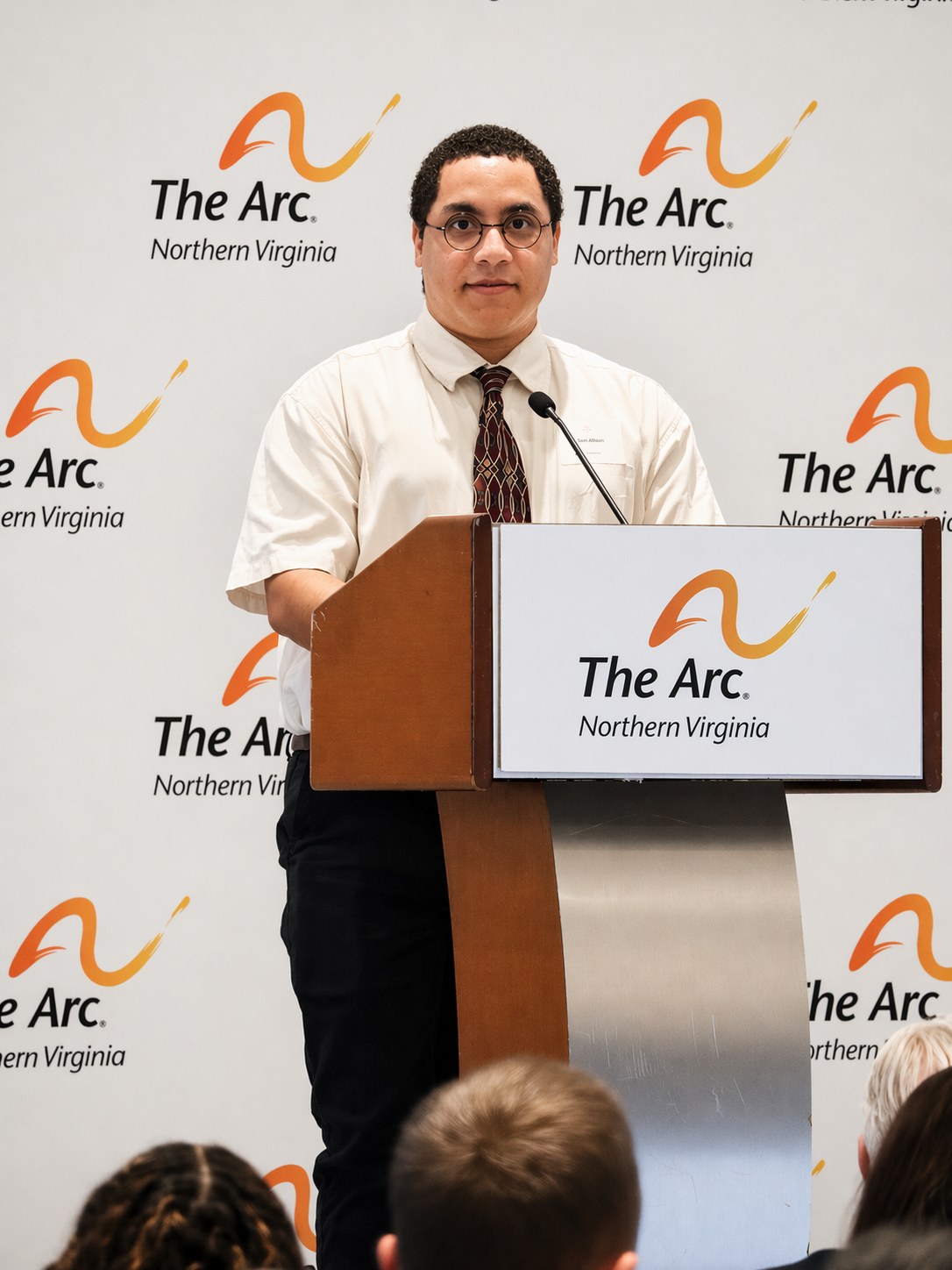
Ian Allan
Self-Advocate for The Arc of Northern Virginia