Introduction: A Life Structured by Negotiation
There are conditions that announce themselves, and there are conditions that must be continuously explained. Avoidant/Restrictive Food Intake Disorder (ARFID) belongs to the latter category, less visible, less immediately legible, yet no less structuring in its impact.
To live with ARFID is to exist within a continuous field of negotiation. This negotiation is not confined to moments of eating, nor is it reducible to preference; it is woven into the very conditions of participation. The act of eating becomes overdetermined, simultaneously physiological, psychological, and performative, requiring a constant calibration between what the body permits and what society presumes.
What follows traces these negotiations across domains that are often taken for granted: infrastructure, ritual, temporality, and discourse. In doing so, it asks not how one adapts to these systems, but how these systems came to appear so natural, and at what cost.
Eating as Infrastructure: When the Ordinary Becomes Structural
In most discourse, eating is treated as incidental, a background activity within the flow of daily life. Yet this apparent neutrality is itself a function of design. Eating is infrastructural: it organizes time, anchors social interaction, and mediates institutional participation.
For those outside its normative parameters, this infrastructure does not disappear; it becomes visible, and with visibility comes negotiation.
The lunch meeting, the celebratory dinner, and the casual invitation to “grab a bite” each instance reveals the extent to which participation is scaffolded around assumptions of ease and uniformity. What is effortless for some becomes conditional for others, contingent upon the ability to navigate systems that were never intended to accommodate variance.
Thus, the negotiation introduced earlier is not an abstraction; it is materially embedded. The ordinary, once examined, reveals itself as structured; its seeming naturalness a product of repetition rather than necessity.
Against the Language of Choice: Rethinking Agency Within Constraint
If infrastructure defines the terrain, the language of choice defines how movement across that terrain is interpreted.
The question, ” Why not simply eat differently?”, emerges from a paradigm that equates agency with volition. Within this framework, deviation from the norm is rendered intelligible only as preference, resistance, or failure of discipline.
But as the prior section suggests, the issue is not merely behavioral; it is structural. And within that structure, agency is neither absent nor absolute; it is negotiated.
ARFID complicates the assumption that individuals can freely align themselves with normative expectations. The body resists; not arbitrarily, but through patterned, embodied responses that do not yield to intention alone. Constraint, in this sense, is not the negation of agency, but its condition.
To insist on choice as the primary explanatory model is to overlook the very negotiations that define the experience. What is required instead is a more nuanced account; one that recognizes agency as situated, contingent, and inseparable from the structures within which it operates.
Social Ritual and Quiet Deviance
If infrastructure organizes participation and agency governs navigation, ritual confers meaning.
Meals function as social rituals, repetitive, symbolic acts through which belonging is affirmed. Their power lies not in explicit enforcement, but in their taken-for-granted nature. One participates not because one must, but because participation appears self-evident.
And yet, as with infrastructure, ritual becomes most visible at the point of friction.
For individuals with ARFID, the act of eating within these contexts introduces a subtle but persistent deviation. The negotiation reappears here, not as logistical calculation alone, but as social positioning. To diverge from the expected script is to risk being read not simply as different, but as misaligned with the ritual itself.
What is striking is how little deviation is required to disrupt the illusion of universality. A modified order, a declined dish, and a moment of hesitation each expose the conditional nature of inclusion.
Ritual, then, is not merely expressive; it is regulatory. It maintains coherence by minimizing visible difference, thereby reinforcing the very norms it appears only to reflect.
Temporal Disruption: Rethinking Progress as Nonlinearity
If ritual stabilizes the present, temporality organizes the future.
The dominant narrative of life progression presumes continuity, movement along a linear path marked by recognizable milestones. Implicit in this model is the expectation that negotiation diminishes over time, that adaptation leads to eventual alignment with the norm.
ARFID unsettles this expectation.
Progress does not eliminate negotiation; it redistributes it. Gains may occur, but they are often partial, context-dependent, and subject to reversal. What appears, from the outside, as inconsistency is, from within, a different temporal logic; one defined less by linear advancement than by sustained navigation within constraint.
This is not merely a personal experience; it is a misalignment between individual temporality and institutional expectation. Systems calibrated to recognize only forward momentum struggle to account for cyclical or asymmetrical patterns.
To reinterpret this as failure is to impose an ill-fitting metric. A more precise account would recognize persistence itself as a form of progression—an ongoing negotiation with time, rather than a departure from it.
Legibility and the Politics of Explanation
Across infrastructure, agency, ritual, and temporality, one demand remains constant: the demand for legibility.
To diverge from the norm is not only to navigate differently, but to explain that navigation. ARFID, lacking immediate visibility, often requires articulation to be acknowledged. And yet, as the preceding sections suggest, what must be explained is not a single behavior, but an entire constellation of constraints.
This produces a secondary layer of negotiation, the negotiation of understanding itself.
Explanation becomes a form of translation: complex, embodied experiences rendered into language that others can accept. But translation is never neutral. It simplifies, compresses, and, at times, distorts.
The burden, moreover, is asymmetrical. The individual must adapt their account to fit existing frameworks, rather than those frameworks expanding to accommodate new forms of knowledge.
In this way, legibility functions as a gatekeeping mechanism. To be understood is to conform, at least partially, to the expectations of intelligibility. What cannot be easily explained risks being dismissed, not because it lacks validity, but because it exceeds the available categories.
Disability Justice as Reorientation, Not Accommodation
If legibility governs recognition, disability justice challenges the terms under which recognition is granted.
Where earlier sections have traced the necessity of negotiation, disability justice asks whether such negotiation should be required at all or, at least, required to the extent that it currently is.
Interdependence reframes constraint, not as an individual burden, but as a shared condition. Collective access reimagines infrastructure, not as fixed, but as adaptable by design. And anti-ableist norms interrogate the rituals and temporalities that privilege uniformity over variation.
In this light, the recurring negotiations that structure life with ARFID are not inevitable; they are produced. And what is produced can, in principle, be reconfigured.
This is not a call for the elimination of difference, but for its integration at the level of design. A world organized around variability would not eliminate negotiation, but it would redistribute it, rendering it mutual rather than unilateral.
Personal Reflection: Between Disclosure and Silence
Within these broader structures, the question of disclosure remains immediate and personal.
When to explain, how to explain, and whether explanation will lead to understanding are not abstract concerns, but lived calculations. The negotiation of legibility becomes internalized, shaping not only how one is perceived but also how one chooses to appear.
There are moments when silence feels like relief, a temporary suspension of translation. And there are moments when articulation feels necessary, even if incomplete, because to remain silent would be to accept misrecognition.
Over time, this oscillation produces a particular awareness: that the effort to be understood is itself unevenly distributed. What is framed as personal difficulty often reflects a broader unwillingness to expand the terms of understanding.
To recognize this is not to resolve the tension, but to locate it more accurately; not within the individual alone, but within the structures that make such negotiation necessary.
Conclusion: Returning to the Question of Normalcy
Some conditions must be explained continuously, and in doing so, something fundamental about the structure of society is revealed.
What began as a discussion of ARFID has unfolded as an examination of normalcy as an organizing principle: one that structures infrastructure, governs ritual, defines temporality, and polices legibility. The continuous field of negotiation described at the outset is not incidental; these overlapping systems produce it, each reinforcing the expectation of alignment.
To live within such a system is not merely to navigate difference, but to render that difference intelligible, often repeatedly, and often without guarantee of recognition.
The question, then, is not whether individuals with ARFID can approximate normalcy, but whether a society that requires continuous explanation from some of its members can meaningfully claim neutrality in the first place.
To return, finally, to where we began: a life structured by negotiation is not, in itself, the problem. The problem lies in why that negotiation must remain so asymmetrical; why some are permitted to exist without explanation, while others must continuously account for their presence within the same shared world.
Note of Thanks
I extend my sincere appreciation to the disability advocacy community, whose continued engagement in articulating lived experience challenges the limits of prevailing paradigms. Through sustained reflection, critique, and collective effort, new possibilities emerge not only for recognition but for reconfiguration. It is within this shared intellectual and ethical labor that more expansive forms of belonging become conceivable.
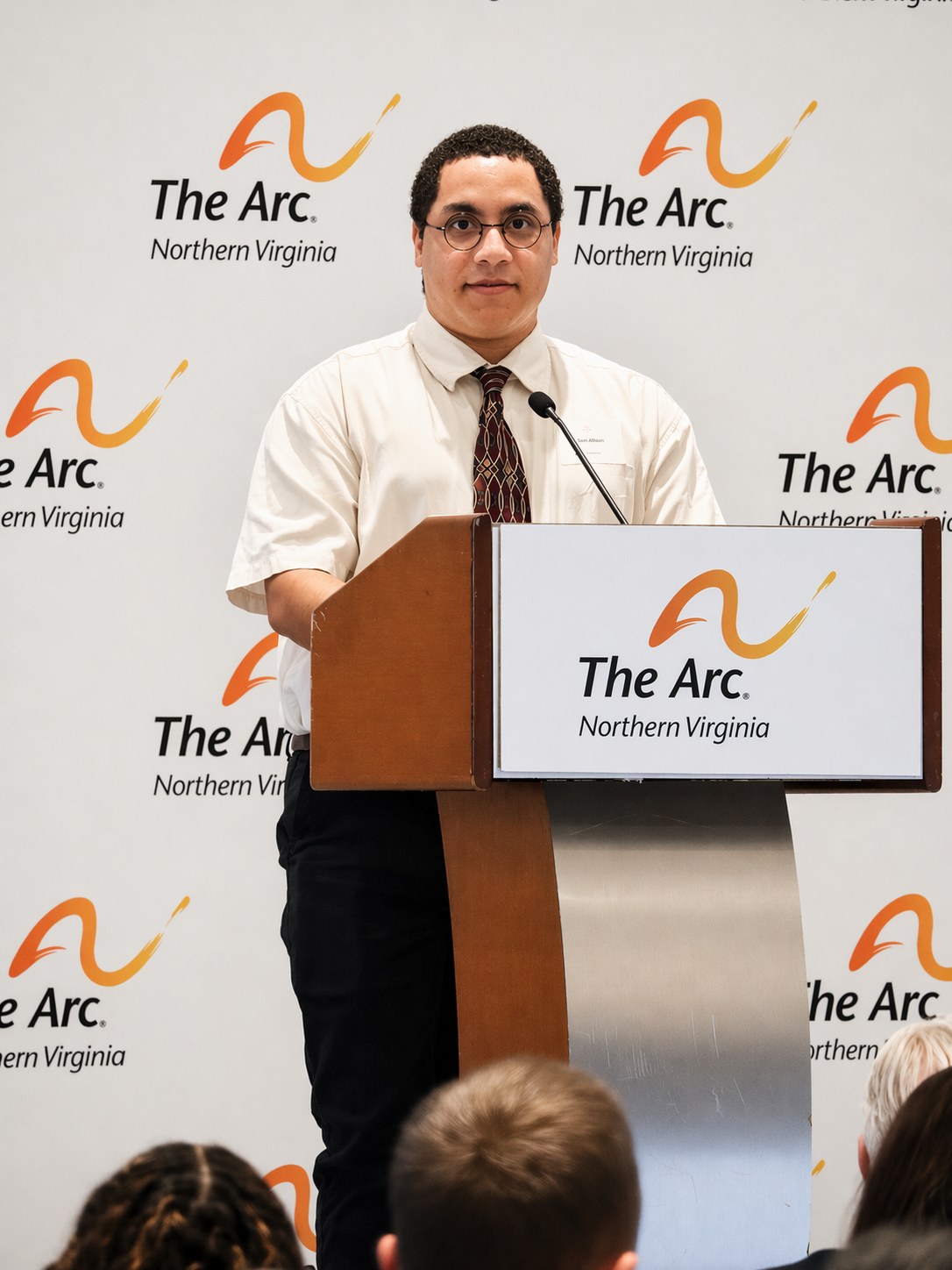
Ian Allan
Self-Advocate for The Arc of Northern Virginia