Introduction: When Experience Resists Language
Modern society is built upon a remarkable confidence in language. We are expected not only to experience our lives but also to explain them. We are asked to identify our feelings, articulate our needs, disclose our struggles, and translate internal realities into socially recognizable forms. Whether in schools, workplaces, healthcare settings, relationships, or public discourse, emotional expression is frequently treated as both a personal responsibility and a marker of psychological competence.
Yet not all experiences arrive in language.
For some individuals, emotions emerge clearly and immediately. For others, emotional awareness develops gradually through reflection, observation, bodily sensation, or retrospective analysis. Between feeling and naming lies a territory that is rarely discussed yet deeply consequential. It is within this territory that many people with alexithymia reside.
Alexithymia is often described as difficulty identifying and describing emotions. While technically accurate, such descriptions can obscure the complexity of the phenomenon itself. They imply an absence where there may instead be a difference in processing, interpretation, and communication. The challenge is not necessarily that emotion is lacking, but that it may not present itself in ways immediately accessible to conscious recognition or verbal articulation.
This distinction matters.
For when a society organizes itself around assumptions of emotional fluency, those whose experiences resist easy translation frequently become responsible for an immense amount of invisible labor. They must decipher sensations, infer meanings, reconstruct emotional narratives, and communicate insights that others may access automatically. In doing so, they illuminate broader questions regarding disability, human variation, and the politics of legibility itself.
This essay explores alexithymia through the lenses of phenomenology, disability studies, and lived experience. More specifically, it examines how the labor of translation required by alexithymia reveals the often-unexamined assumptions that govern emotional communication and challenges us to imagine a more expansive understanding of what it means to know ourselves and one another.
Beyond the Clinical Definition: Reconsidering Alexithymia
The prevailing clinical framework describes alexithymia through identifiable characteristics: difficulty recognizing emotions, difficulty describing emotions, a tendency toward externally oriented thinking, and reduced emotional differentiation. These descriptions provide useful points of entry, yet they often fail to capture the richness and variability of lived experience.
Clinical language frequently privileges observable outcomes. It describes what can be measured, categorized, and codified. However, what becomes visible within diagnostic frameworks is not always synonymous with what is experienced.
A person with alexithymia may possess profound emotional depth while struggling to identify its precise contours. Another may recognize distress physiologically long before understanding its emotional significance. Still another may discover emotional meaning only after extensive periods of reflection.
Such realities challenge the implicit assumption that emotional awareness is necessarily immediate.
Indeed, one of the most important insights offered by alexithymia is that emotional experience and emotional interpretation are not identical processes. They may occur simultaneously, but they need not. Feeling something and knowing what one feels can be separated by minutes, hours, days, or even longer.
The distinction is subtle, yet philosophically significant. It suggests that emotional knowledge is not always a direct perception but sometimes an act of interpretation.
The Hegemony of Emotional Fluency
Much of contemporary culture operates according to what might be called the hegemony of emotional fluency.
From early childhood onward, individuals are encouraged to identify emotions quickly, communicate them clearly, and demonstrate emotional self-awareness through verbal expression. Educational systems reward emotional articulation. Therapeutic models often rely upon it. Interpersonal relationships frequently assume it.
The expectation appears so natural that it is rarely questioned.
Yet emotional fluency is not a universal human experience. Rather, it represents one particular mode of engaging with internal life that has become culturally normalized and institutionally reinforced.
The consequences of this normalization are significant.
When emotional identification becomes a social expectation, those who experience emotions differently may be perceived through a deficit lens. Difficulty articulating feelings can be interpreted as emotional immaturity, lack of empathy, poor self-awareness, or interpersonal disengagement.
Such interpretations reveal the limitations of the dominant paradigm more than they reveal the capacities of the individual.
What is often treated as a personal shortcoming may instead represent a mismatch between diverse forms of human cognition and social structures designed around a narrower conception of emotional competence.
The Labor of Translation
Perhaps the most underappreciated aspect of alexithymia is the labor it demands. This labor is not always visible because it occurs internally.
Before answering a question about how one feels, there may be an extensive process of investigation. Bodily sensations are examined. Environmental stressors are reviewed. Recent events are reconsidered. Patterns are compared against previous experiences.
Possible explanations are generated and tested. Only then may an emotional interpretation emerge.
The process resembles translation in its most literal sense.
Translation requires movement between systems of meaning. The translator inhabits a space between languages, continually navigating ambiguities, approximations, and contextual nuances. Similarly, many individuals with alexithymia find themselves
translating between physiological experience, cognitive observation, social expectation, and emotional language.
The result is a form of labor that remains largely unrecognized because its successful completion often renders it invisible.
People encounter the final translation but rarely witness the work required to produce it.
The Phenomenology of the Unnamed
Phenomenology, as a philosophical tradition concerned with lived experience, provides a valuable framework for understanding alexithymia.
Rather than asking what emotions are in an abstract sense, phenomenology asks how emotions appear within consciousness.
For many people, emotional awareness is experienced as immediate recognition. For others, awareness emerges indirectly. Emotions may first present themselves as physical discomfort, altered energy levels, changes in concentration, sensory overwhelm, or unexplained tension.
Meaning arrives later.
This temporal gap creates a distinctive phenomenological experience: one knows that something is occurring without immediately knowing what that something is.
The experience is not necessarily characterized by absence. Rather, it is characterized by ambiguity.
Within the interstices between sensation and interpretation, individuals often engage in ongoing processes of observation and inference. They become investigators of their own experiences, constructing understanding through analysis rather than intuition.
Such experiences complicate simplistic assumptions about emotional awareness and invite a richer appreciation of cognitive diversity.
Disability, Neurodivergence, and Emotional Accessibility
Within disability communities, alexithymia occupies a particularly important position because it frequently intersects with broader questions concerning accessibility, accommodation, and recognition.
Many discussions of disability focus on physical barriers. Others emphasize communication barriers, sensory barriers, or institutional barriers. Less frequently discussed are emotional barriers—those created when societies assume a singular pathway toward emotional understanding.
This assumption can produce subtle forms of exclusion.
When emotional competence is narrowly defined, individuals who communicate differently may find themselves continually required to justify, explain, or defend their experiences. They may encounter skepticism when they cannot immediately identify feelings. They may be judged according to standards that fail to account for neurodivergent modes of processing.
From a disability justice perspective, the goal is not to compel conformity to dominant emotional norms. Rather, it is to cultivate environments capable of accommodating multiple forms of emotional awareness.
Such an approach aligns with principles of collective access and interdependence. It recognizes that accessibility is not merely a matter of physical design but also of social expectation.
An accessible society acknowledges that people arrive at understanding through different routes.
Personal Reflection: Learning to Live in the Space Between
My own experiences have led me to view emotional awareness less as a destination and more as an ongoing interpretive process.
There have been many occasions when I recognized that something within me had shifted long before I could explain what that shift represented. I sensed tension, unease, exhaustion, or discomfort, yet lacked the immediate vocabulary necessary to describe the experience.
From the outside, such delays may have appeared insignificant. Internally, however, they often involved extensive effort.
I learned to observe patterns.
I learned to examine environmental conditions.
I learned to revisit conversations and reconstruct emotional contexts after the fact.
Most importantly, I learned that delayed understanding is not the same as absent understanding.
This realization transformed my relationship with myself. Rather than interpreting uncertainty as failure, I began to see it as evidence of a different processing style—one that required patience, reflection, and intellectual curiosity.
The challenge was not that emotion was missing.
The challenge was that emotion often arrived without subtitles.
Toward a More Expansive Understanding of Human Difference
Alexithymia ultimately raises questions that extend far beyond emotional identification.
What kinds of knowledge are recognized as legitimate? Which forms of communication are privileged?
How do social institutions determine what constitutes competence, self-awareness, or authenticity?
These questions reveal the extent to which emotional expression has been codified according to specific cultural expectations. They also expose the limitations of frameworks that equate difference with deficiency.
A more inclusive paradigm would acknowledge that human beings engage with their internal worlds through diverse pathways. Some arrive at understanding through intuition. Others through reflection. Some through conversation. Others through observation.
None of these routes possesses an inherent monopoly on legitimacy.
The task is not to eliminate difference but to create conditions in which difference can exist without penalty.
Conclusion: Naming the Unnamed
Alexithymia reminds us that not every aspect of human experience can be immediately articulated, categorized, or translated into language.
In a culture that often privileges speed, certainty, and verbal fluency, this reality can be difficult to accommodate. Yet it also offers an opportunity to reconsider some of our most fundamental assumptions about emotion, communication, and self-knowledge.
The labor of translation undertaken by many individuals with alexithymia is not merely a personal challenge. It is evidence of a broader social arrangement in which emotional legibility is often mistaken for emotional validity.
To recognize this labor is to recognize a form of human work that frequently remains unseen.
More importantly, it is to acknowledge that some of the most meaningful dimensions of human experience emerge not in the certainty of what can be easily named, but in the ongoing effort to understand what cannot.
Note of Thanks
I extend my sincere gratitude to the disability advocates, neurodivergent communities, researchers, clinicians, caregivers, and individuals whose lived experiences continue to deepen public understanding of alexithymia and emotional diversity.
I am especially grateful to those who have shared experiences that challenge dominant assumptions regarding communication, emotional expression, and self-awareness.
Through their willingness to inhabit complexity rather than reduce it, they have expanded public discourse and encouraged more nuanced conversations about human difference.
May our collective efforts continue to advance anti-ableist norms, strengthen collective access, and foster communities in which understanding is not contingent upon conformity but enriched by the many ways human beings experience, interpret, and communicate their worlds.
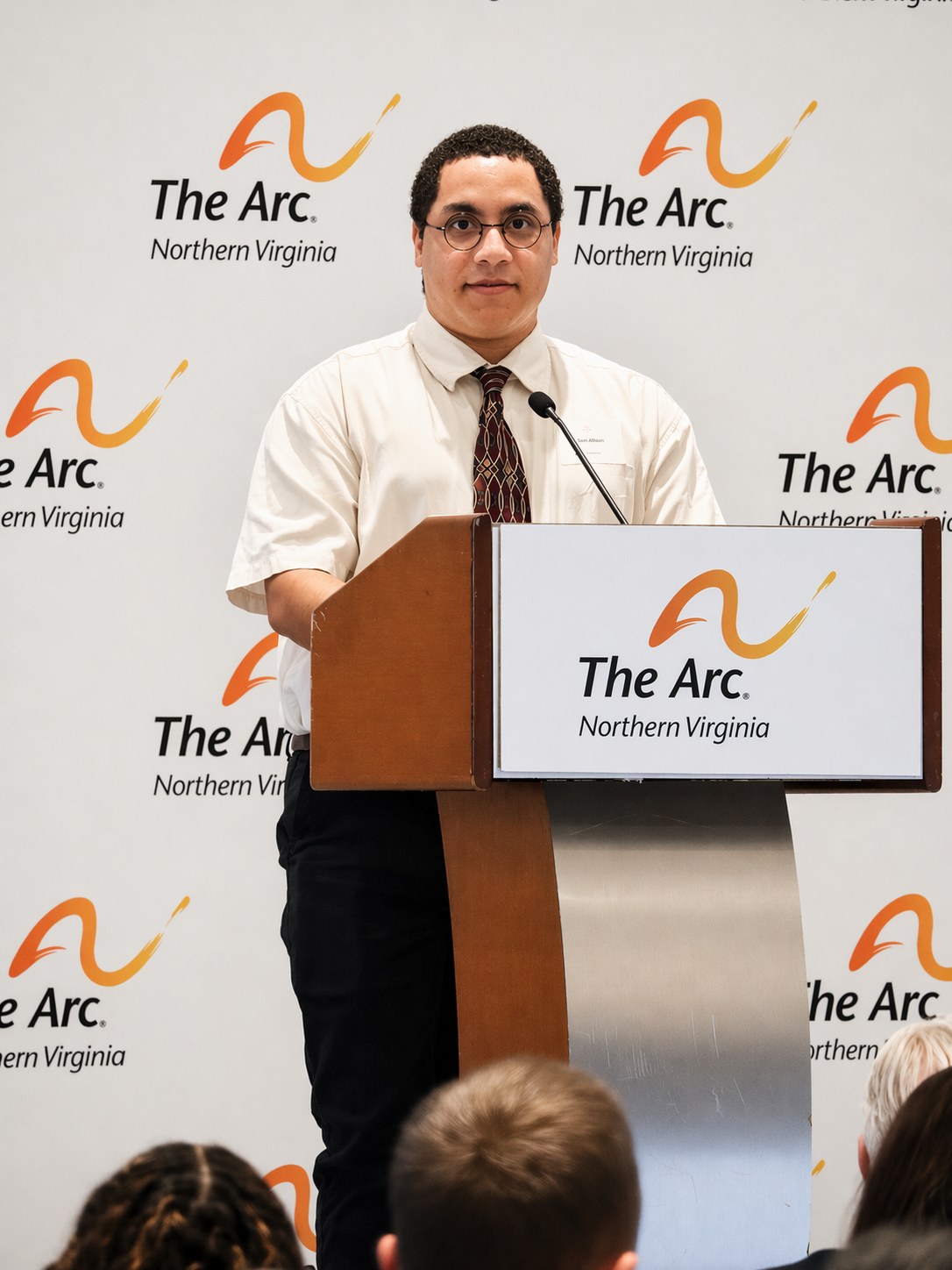
Ian Allan
Self-Advocate for The Arc of Northern Virginia